Proster Dual Channel Thermometer Review
Introduction
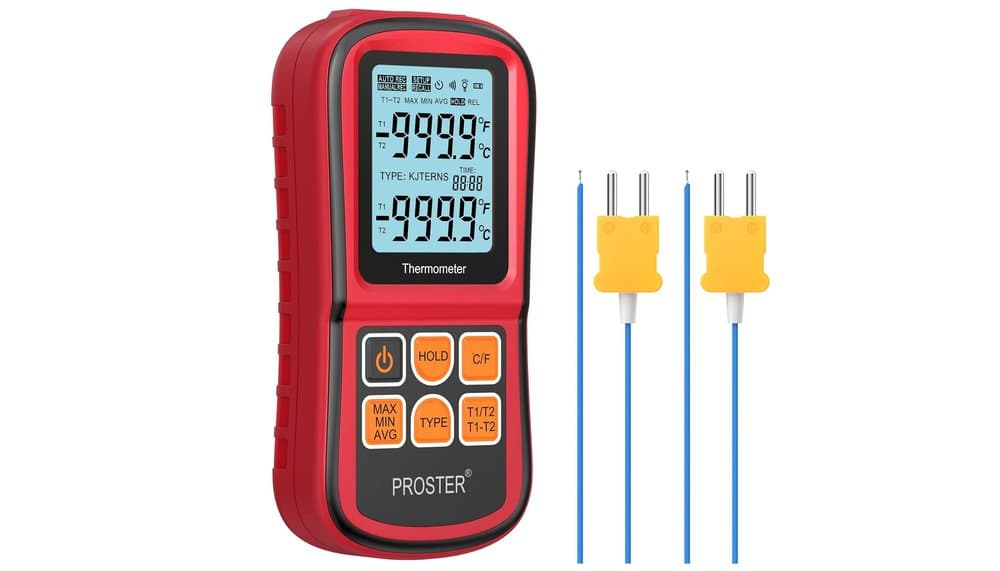
For practitioners of precision cooking, temperature measurement is not a simple check; it is the foundation of absolute control. Whether fine-tuning the stability of a water bath for 72-hour sous-vide, checking the uniformity of a pizza oven, or calibrating a new immersion circulator, having a reliable measurement tool is essential. The entrance of the Proster Double Channel Digital Thermometer with Two K-Type Thermocouples promises precisely this versatility and accuracy at an accessible level. It is not a circulator, but a diagnostic and validation tool. In this analysis, we will dissect its specifications and community feedback to determine if it constitutes a serious asset for the precision cooking enthusiast's toolkit.
Key Strengths
- Simultaneous Dual-Channel Measurement: The ability to read two temperatures in real-time on a single screen, and to calculate their difference (T1-T2), is its flagship feature. Ideal for comparing the core temperature of two pieces of meat, or checking uniformity between the top and bottom of a water bath.
- Theoretically Suitable Accuracy and Resolution: On paper, the specifications state an accuracy of ±0.1% + 0.6°C and a resolution of 0.1°C. For sous-vide cooking, where deviations of 0.5°C can influence the outcome, these figures are in the right range.
- Probe Versatility: The device accepts a wide range of thermocouple probes (J, K, T, E, R, S, N). Although it comes with two K-type probes, this allows for an upgrade to higher quality probes or ones suited for specific uses (e.g., needle probe for solids).
- Autonomy and Portability: Powered by AAA batteries and supplied with a carrying case, it is designed to be quickly deployed at any cooking station, away from a power outlet.
Weaknesses
- Uneven Quality of Included Probes: This is the main point of friction highlighted by users. The included K-type probes are described as the weak link, with limited durability, a lack of strain relief at the connectors, and sometimes unstable readings if the cable is mishandled.
- Perceived Basic Housing Construction: Many reviews mention a plastic housing that feels "a bit flimsy" or seems fragile compared to laboratory equipment. This does not necessarily affect function, but impacts the perception of robustness.
- Complete Lack of Connectivity: This thermometer is a purely local instrument, with no Wi-Fi, Bluetooth, or dedicated app. For very long cooks, remote monitoring is impossible. It is a tool for spot-checking or calibration, not for permanent monitoring.
- Measurement Process Requiring Rigor: Testers emphasize the need to wait for the reading to stabilize upon power-up and to ensure the probe connectors are fully inserted to avoid ghost readings.
Detailed Analysis for Precision Cooking
Accuracy and Stability: What Are the Numbers Really Worth?
The specs state an accuracy of ±0.1% + 0.6°C. Concretely, at 60°C (typical temperature for a steak), the maximum theoretical error margin is ±0.66°C. Feedback from users who performed verification checks is generally reassuring. One tester compared measurements to a reference system (Arduino with a DS18B20 probe) and noted minimal deviations: 0.1°C at room temperature and on ice water, and 99.8°C for boiling water. The stability, according to reviews, is good once the measurement is stabilized, which is crucial for validating a circulator's regulation.
However, this accuracy depends heavily on probe quality. As one user points out, the included K-type thermocouples are Class 2, with an intrinsic tolerance that can reach up to ±2.5°C. The measured performance is therefore actually a contest between the quality of the measurement module (good) and that of the entry-level probes (average). For demanding culinary use, purchasing higher quality probes is strongly recommended.
Performance for Long Cooks and Versatility
For cooks lasting 24 hours and more, the Proster is not designed as a continuous monitoring tool. Its auto-off feature (about 8 minutes) can be disabled according to the manual, but its battery power and the lack of any alarm other than a beep make it poorly suited for this role. Its real value here is calibration and diagnostics: periodically checking that the immersion circulator maintains the correct temperature throughout the height of the bath (with its two probes) or measuring the core temperature of a product before and after a long cook.
Its versatility is its main asset. Beyond sous-vide, it can be used to:
- Calibrate an oven or smoker by placing a probe at different levels.
- Measure oil temperature for precise frying.
- Check fermentation temperatures (yogurt, cheese).
- With a suitable probe, probe the internal temperature of bread or roasts in the oven.
Build Quality and User Experience
The housing, described as hard plastic, is judged to be functional but no-frills. The buttons have good tactile feedback according to reviews. The LCD display with backlight is unanimously praised for reading in a poorly lit kitchen or near an oven. The MAX/MIN/AVG (average) functions are practical for tracking temperature evolution over a period.
The recurring negative point concerns the probe connectors. They are described as "a bit schwergängig" (hard to manipulate) and, most importantly, the supplied probes have no strain relief. A sudden tug can damage the internal wiring, which explains some reviews reporting early failures.
What's Missing for Seasoned Enthusiasts
The experienced user will search in vain for features that have become common in the precision realm: no wireless connectivity, thus no remote monitoring via smartphone. No data logging to trace a cooking profile. No sophisticated programmable alarms. The Proster clearly positions itself as a manual and local measurement instrument, a digital and more precise equivalent of a quality instant-read probe thermometer, but with two channels.
Technical Specifications
| Feature | Detail |
|---|---|
| Model | Proster Double Channel Digital Thermometer |
| Channels | 2 (T1 and T2), simultaneous display and T1-T2 difference |
| Measurement Range (Unit) | -200°C to 1362°C (-328°F to 2484°F) |
| Stated Accuracy | ±0.1% of reading + 0.6°C |
| Resolution | 0.1°C / 0.1°F |
| Compatible Probe Types | K, J, T, E, R, S, N (manual selection) |
| Included Probes | 2 x Type K Thermocouple (-50°C to 300°C) |
| Display | Digital LCD with backlight |
| Functions | MAX, MIN, AVG (average), HOLD, °C/°F |
| Power Supply | 3 x AAA batteries (included) |
| Auto Power Off | Approximately 8 minutes (disablable) |
| Construction | Plastic housing |
| Accessories | Carrying pouch, manual |
What Users Say
A synthesis of 883 global reviews (average rating 4.2/5) and feedback from technical experts paints a nuanced and consistent picture of the product.
Praise focuses on:
- Value for money: It is very often described as "very good" or "excellent" for its price.
- Perceived accuracy: Many users find it "accurate", "reliable", with a "tiny" difference between the two probes. Comparative tests with other instruments confirm this reliability of the core module.
- Dual-channel function: Appreciated as "very handy" for comparative measurements, whether in cooking, forging, or technical applications.
- Ease of use: It is described as intuitive and easy to get started with.
Criticism and warnings are centered on:
- Quality of supplied probes: This is the main sore point. Reviews like "crappy thermocouples" or "glapp i en probe direkt" (a probe faulty upon delivery) recur. Their fragility at the cable/connector junction is highlighted.
- Durability/Quality Roulette: Some reports of devices failing after little use ("already broken after 2 uses").
- Housing construction: Described as "basic" or having a "cheap look", even if it doesn't hinder function.
- Noise: The beep sound is judged too loud by some, with one user even modifying the device by sticking tape over the buzzer to dampen it.
A common piece of advice is repeated: consider this device as a good base module, but budget for the purchase of higher quality thermocouple probes (with insulation and strain relief) for serious and long-term applications.
Conclusion
The Proster Double Channel Digital Thermometer is a tool that finds its place in the precision cook's arsenal, but with a well-defined role. It is not a competitor to the connected probes of high-end immersion circulators. It is primarily a versatile verification, calibration, and diagnostic instrument.
For the beginner wanting to go beyond a basic thermometer, it offers an accessible entry point to precise two-point measurement, useful for understanding temperature gradients in an oven or water bath. For the experienced enthusiast, it serves as a reliable second opinion, a calibration tool for other devices, and an ideal companion for DIY projects outside the kitchen (smoking, fermentation, etc.), provided it is paired with robust probes.
Its main advantage is its versatility and respectable core accuracy; its main flaw is the perceived fragility of the supplied accessories. If you accept the included probes as starter consumables and are looking for a reliable, manual, digital thermometer capable of measuring two things at once, the Proster delivers on its promises. If you absolutely need remote monitoring, data logging, or industrial robustness for intensive use, you will need to look (and invest) elsewhere.
100% free and independent — All our articles are written independently, without any sponsorship. We may earn a commission on purchases made through our links, at no extra cost to you.
Articles you might like
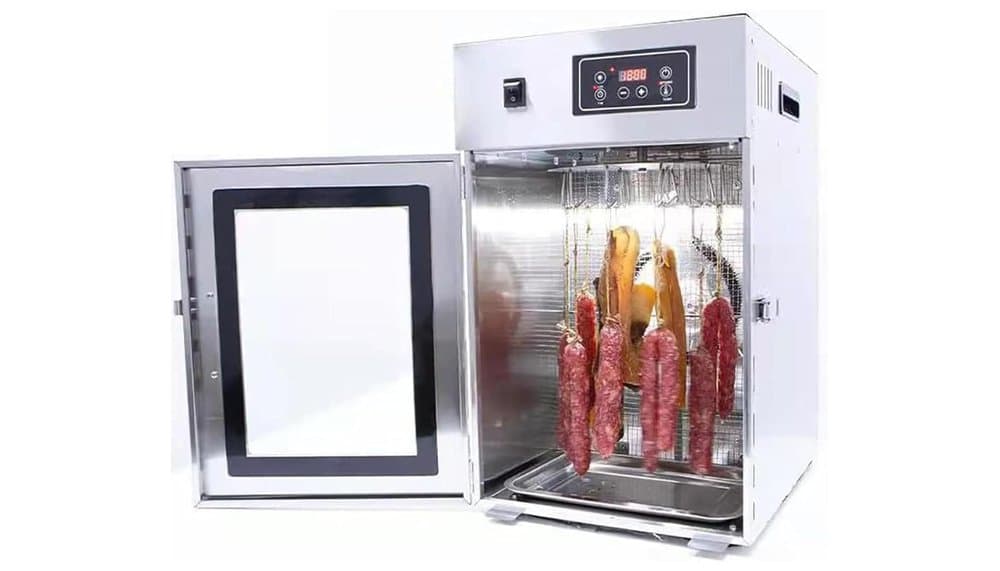
CGLYYDS Professional Meat Dryer & Dehydrator Test
Extend sous-vide creations with the CGLYYDS meat dryer & dehydrator. Master preservation and create new textures with precise, controlled results.

Amazon Basics Vacuum Sealer Rolls Review & Test
Meta description: Analysis of Amazon Basics vacuum sealer rolls for sous-vide cooking. Are they reliable for long cooks? Read our full review.

Buffalo DM868 Immersion Heater Review & Performance Test
Buffalo DM868 immersion heater sous vide review: power & simplicity at a low price, dissecting this older, robust circulator's performance & value.
Guides you might like
Bell Jar Vacuum Sealer Buying Guide
Upgrade to a chamber vacuum sealer for professional sous-vide results at home. Perfect for liquids and flawless, long-lasting seals.
Best Beginner Sous Vide Kit
Find the perfect sous-vide starter kit on a budget. Learn the three essential features to look for to cook your first perfect steak without the headache.
Best Vacuum Bags
Choose the right vacuum sealer bags for perfect results. Learn key specs like heat resistance, thickness, and barriers to avoid culinary disasters.