Vacuum Sealer Buying Guide
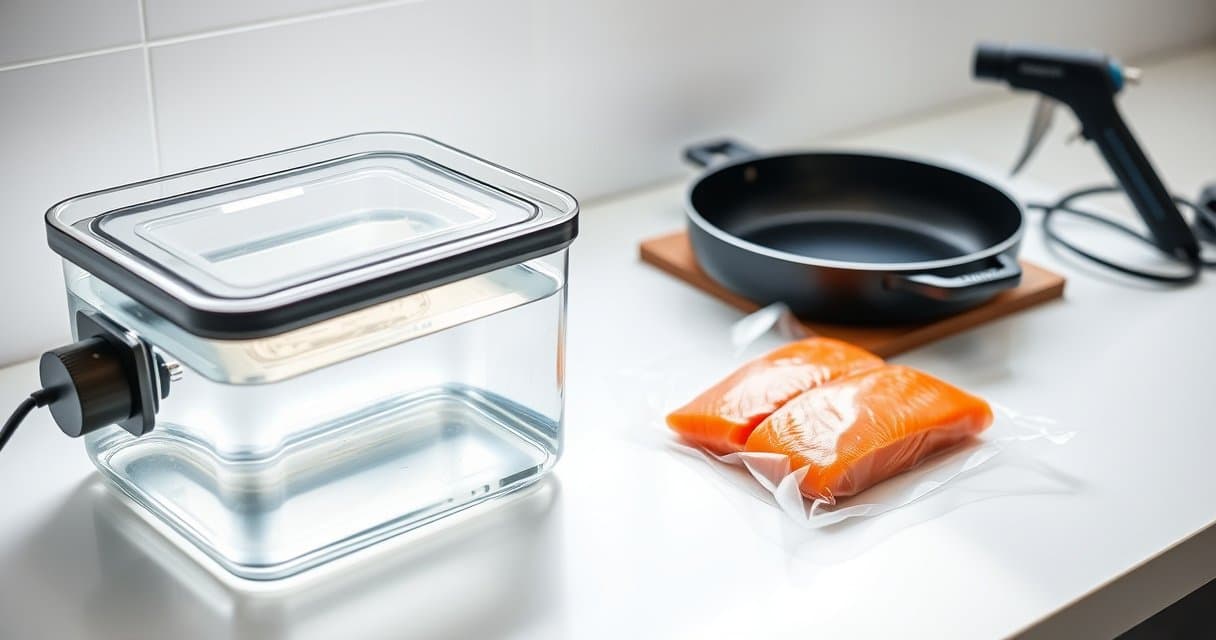
Imagine being able to cook a perfectly even steak, keep it fresh in the fridge for days without losing quality, and reheat it to perfection in an instant — all thanks to a single appliance. Frankly, a sous-vide machine worthy of the name is much more than a simple gadget: it's a tool that radically transforms your relationship with cooking, from meal planning to cooking precision. I'll explain how to make the right choice.
Key Takeaways
- Precision and thermal stability are essential: a tolerance of ±0.5°C is sufficient for everyday use, but stability over long cooking times is crucial.
- The type of pump (external or chamber) depends on your food: external is suitable for solids, while a chamber sealer is indispensable for easily sealing liquids.
- The power and water flow rate are as important as the capacity: they ensure rapid temperature rise and even cooking, especially for large volumes.
- Choose advanced functions (programs, connectivity) based on your frequency of use: they are a real comfort gain for intensive users.
- Align your purchase with your usage profile (occasional, regular, or intensive) to find the tool that will integrate perfectly into your culinary routine.
Understanding Thermal Precision and Its Impact in Cooking
This is the heart of any successful sous-vide cooking. If your machine does not hold the promised temperature, you lose the main advantage of the technique: absolute control over the outcome. We are talking about the difference between a perfectly creamy egg at 63°C and a rubbery texture at 64°C. It's that precise.
The Advertised Tolerance: ±0.1°C or ±0.5°C, It Makes All the Difference
Manufacturers indicate an accuracy, often ±0.5°C for entry-level models, and ±0.1°C for more serious machines. These numbers are not pure marketing. A tolerance of ±0.5°C means your water can actually fluctuate between 60.5°C and 61.5°C if you set it to 61°C. For most meats and vegetables, this is acceptable. But if you are aiming for the precise texture of a delicate fish or a creamy egg yolk, that half-degree difference becomes noticeable. Machines with ±0.1°C are designed for enthusiasts and competition-level results. Frankly, unless you are getting into molecular gastronomy at home, a good ±0.5°C is often sufficient for everyday cooking.
Stability: The True Measure of Quality
This is often where the difference between a good and a better immersion circulator lies. A machine can precisely reach the target temperature but struggle to maintain it, especially when you plunge a large, cold piece of meat into the bath. The heating power and the efficiency of water circulation come into play. An unstable machine will have to "sprint" to catch up to the temperature drop, causing oscillations and unpredictable cooking times. For long cooks of 24 to 48 hours, like pulled pork or duck confit, this stability is non-negotiable.
Concrete Example: Cooking a Ribeye Steak
Take a ribeye steak you want to cook at 56°C for a perfect pink center.
- With a stable machine at ±0.1°C: It maintains a bath between 55.9°C and 56.1°C for 4 hours. The result is uniform from the center to within 1 mm of the surface.
- With a machine oscillating at ±1°C (they exist): The temperature can rise to 57°C near the heating element. You risk a thin band of overcooked meat all around the steak, compromising tenderness.
My advice? Focus less on the advertised precision number alone and more on user tests regarding stability under full load. A machine that promises ±0.5°C and keeps that promise even with 20 liters of water and 5 kg of food is often better than a "theoretically" more precise but underpowered model. For short cooks (chicken, vegetables), don't break the bank. For long and ambitious projects, invest in stability.
The Types of Vacuum Sealing and Their Usefulness for Your Food
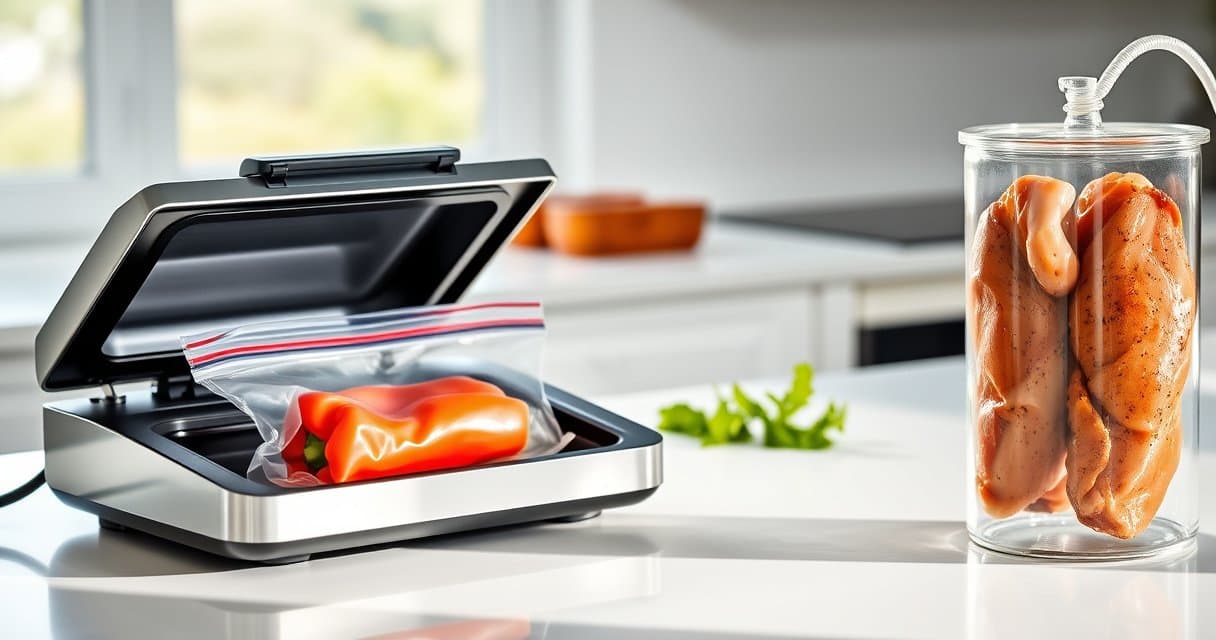
The whole point of vacuum sealing, even before cooking, is to evacuate air efficiently. And the method used determines what you can seal, and above all, how your food will behave. It's not just about the machine, it's about the result on the plate.
Classic External Vacuum Sealing: For Bags and Everyday Use
This is the most common system on kitchen machines. A sealing bar, an edge of the bag placed in the channel, and the integrated vacuum does the rest. Simple. But pay attention to the details that make the difference:
- Pulse or continuous mode? Pulse mode allows you to stop the suction manually. Invaluable for sealing fragile foods like strawberries or a delicate fish fillet without crushing them. A continuous-only mode risks having raspberry purée in your bag.
- Suction pressure: It is often measured in bars or CFM (airflow). Stronger pressure allows for a deeper vacuum on large bags (a big roast) or with liquids. A better food vacuum sealer will have a motor powerful enough to handle this without running out of breath after 10 seconds.
It's your ally for 90% of uses: meats, vegetables, soups (letting them cool a bit first), cheeses. For regular family use, it's more than enough.
Chamber Vacuum Sealing: The Secret Weapon for Liquids and Intensive Preparation
Here, we change categories. Here, the entire bag is placed inside a sealed chamber. You close the lid, the machine sucks the air out of the entire chamber, then seals. The advantages are revolutionary for certain uses:
- Perfect sealing of liquids. You can seal a marinade, soup, or sauce directly, with absolutely no risk of liquid being sucked into the machine. It's a real time-saver.
- Speed and repeatability. You seal several bags in a row without having to reposition each edge. Ideal for weekly meal prep.
- Deeper and more uniform vacuum. Perfect for porous foods (cakes soaked in syrup, soft cheeses) where you need to eliminate all air from the food itself.
The flip side? The bulkiness, the price, and the cost of specific bags (often more expensive than standard rolls). It's an investment for meal prep enthusiasts or those who regularly cook with lots of sauces.
My Decisive Opinion: Which System to Choose?
Don't assume a chamber vacuum sealer is "always better." It all depends on your fridge and your style.
- You mainly cook cuts of meat, steamed vegetables, and freeze portioned meals? An excellent external vacuum sealer with a good pulse mode will do the job perfectly, for a much lower budget.
- You prepare liquid marinades every week, you love vacuum infusions (fruit in alcohol is magical), and you package industrial quantities of stews every Sunday? Then, the chamber vacuum sealer is no longer a luxury, it's a productivity tool. Honestly, it pays for its investment in time saved and frustration avoided.
Think about what you really want to seal. Your answer will tell you which type of vacuum sealing to look for.
Our Selection
This month, we've broken down three vacuum sealing appliances from the Bonsenkitchen brand. Although they share a common DNA, they present notable differences in terms of materials, features, and intended use. We've analyzed their technical specifications and user feedback to help you navigate this overwhelming offering.
| Product | Material | Operating Modes | Design & Portability | Key Strengths (based on reviews) |
|---|---|---|---|---|
| Bonsenkitchen Vacuum Sealer (White) | Plastic | Semi-Automatic (4 modes) | Compact, easy storage | Sealing speed, modal versatility |
| Bonsenkitchen Food Vacuum Sealer (Silver) | Stainless Steel | Automatic | Professional design | Double-seal welding, finish |
| Bonsenkitchen Food Vacuum Sealer Machine (Black) | ABS (reinforced plastic) | Automatic | Ultra-compact, integrated storage | Optimal space saving, organization |
Bonsenkitchen Vacuum Sealer (White)
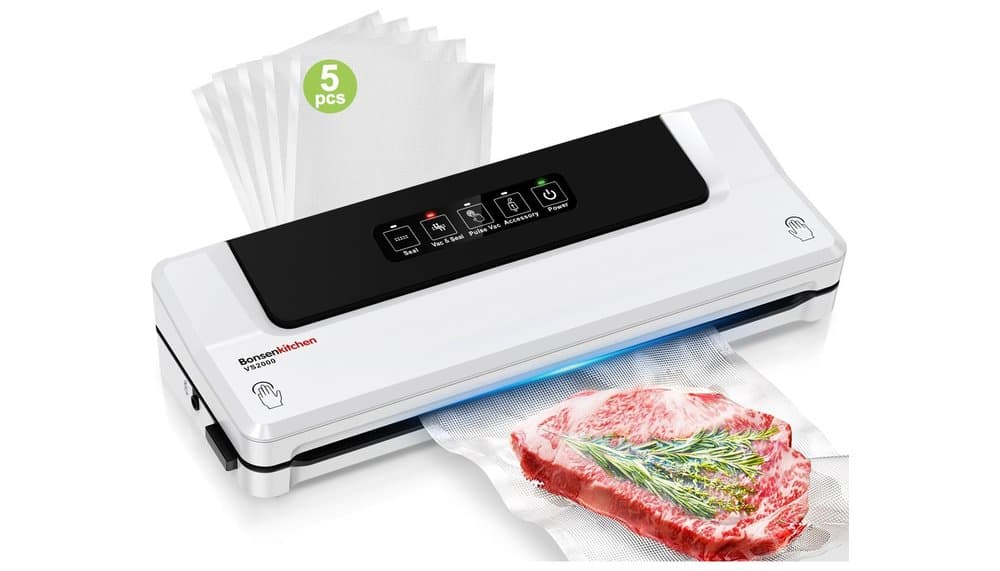
This first model positions itself as the versatile entry-level option with its white plastic casing. On paper, its four operating modes promise good adaptability: a simple seal mode, an automatic mode (Vac&Seal) for most dry foods, a manual mode (Pulse Vac) for delicate products like bread, and finally an accessory mode for jars.
What interests us here is its practicality for occasional to regular use. The community notes that its sealing speed is indeed an asset for quickly processing multiple portions. Its compact size is also frequently praised for discreet storage in a drawer. However, several user reviews point out concrete limitations. The plastic construction can feel less robust and less prestigious in use than a stainless steel model. Furthermore, while versatile, its effectiveness on very moist foods is, according to feedback, improvable and requires mastering the Pulse mode to avoid incidents. It therefore remains an excellent companion for those starting out or who don't need daily intensive use.
Bonsenkitchen Food Vacuum Sealer (Silver)
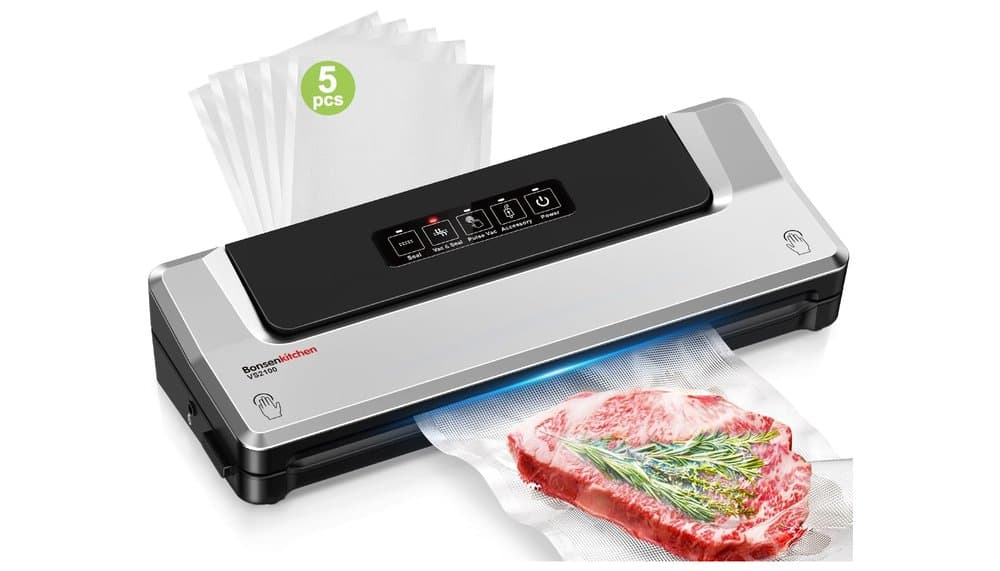
This second model sports a stainless steel finish, immediately giving it a more professional and durable look. Technically, it shares the same four modes as its white counterpart, but its operation is described as automatic, which might indicate a simplified interface or smarter process management.
The real differentiating point highlighted in its specifications is the double-seal welding technology. According to user feedback, this characteristic seems to translate to increased reliability of the seals over the long term, reducing the risk of vacuum loss, especially for prolonged freezing. The metal finish is also appreciated for its easy cleaning and resistance to marks. In return, the community notes that its footprint is slightly less compact, and its weight can be a bit more. This model therefore seems tailored for those who prioritize robustness and performance over time and use their vacuum sealer fairly regularly.
Bonsenkitchen Food Vacuum Sealer Machine (Black)
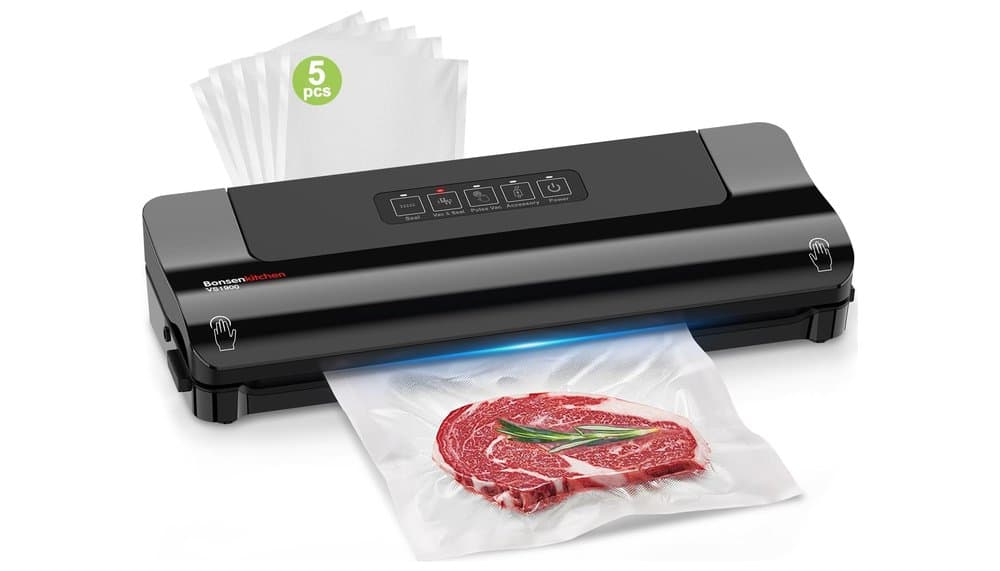
This third product, with its ABS black casing, stands out for its obsession with optimized storage. Its dimensions are the most compact in the selection, and it integrates a particularly practical feature: an integrated slot for winding the power cord. On paper, this makes it the champion of organization for small kitchens or for people who want to take out and put away the appliance after each use without hassle.
Like the others, it offers the four modes (Seal, Vac&Seal, Pulse Vac, Accessory) with automatic operation. Reviews agree in praising its minimal footprint, making it an ideal candidate if your counter space is limited. However, some users point out a slightly lower suction capacity on large or very full bags compared to larger models. The ABS material, while sturdy, can also give a less "premium" feel than stainless steel. This model therefore finds its audience with those for whom compactness and ease of storage are the decisive criteria, over raw power.
What Capacity and Circulation Power Reveal
Looking at the technical specifications is fine. But understanding what these numbers really mean in your kitchen is better. The advertised capacity and the circulator's power aren't just marketing: it's the promise that your Easter leg of lamb or your 8 chicken breasts will cook perfectly evenly. And there, there's often a gap between theory and practice.
Capacity (in liters): The Big Misunderstanding
The number you see — 10L, 20L, 30L — usually corresponds to the maximum volume of the container the machine can heat. But your real limit is your biggest stockpot or your dedicated cooler. More importantly: the usable capacity. An 800W circulator in a 20L bucket of cold water will take forever to reach 85°C for duck confit. For high-temperature and high-volume cooking, the power must match the volume.
Here is a simple rule I use:
- Up to 15-18L (a large stockpot): A 1000-1200W circulator is comfortable for most cooks, even long ones.
- Beyond 20L (a cooler for a large cut): Aim for at least 1500W. This ensures a reasonable heating time and impeccable thermal stability, even when opening the lid.
Don't forget: always fill your container at least 2/3 full to ensure good circulation. A machine in too large a volume of water is like a small engine in a big truck: it struggles.
Circulation, the True Heart of the System
This is where cooking uniformity happens. A circulator doesn't just heat; it vigorously stirs the water to eliminate cold spots.
- Low flow (say, less than 8L/min) may be enough for a small bath, but in a large volume, you risk temperature gradients. Your steak at the edge could be at 55°C while the one in the center is at 57°C. Over a long cook, the difference is real.
- Powerful flow (above 12-15L/min) ensures homogeneous mixing, regardless of bag shape or container layout. This is crucial for competitive sous vide cooking or simply for peace of mind.
Another underestimated point: noise. Circulation that sounds like a small boat engine can drive you crazy if you're doing a 48-hour cook in your open-plan kitchen. High-end models often excel on this point.
A Concrete Example to Clarify Everything
Imagine wanting to cook 6 large salmon steaks in a 12L container.
- With a low-end circulator (800W, modest flow): The water will take time to reach 45°C. Once at temperature, poorly positioned bags can partially block the flow. Result? Parts of the fish less well cooked, a texture not perfectly uniform.
- With a better food sous vide machine (1200W+, strong flow): The temperature rise is fast. The constant water current envelops each bag, guaranteeing that every millimeter of salmon bathes in water at the exact temperature. The difference is felt when tasting: perfect creaminess everywhere.
My advice? Don't settle for just the biggest capacity number. Ensure that the heating power (in Watts) and the circulation strength (look for the flow rate in L/min) match your actual uses. For occasional use, a standard model is fine. For intensive meal prep sessions or large cuts, invest in a robust system. It's the kind of detail that makes the difference between an adequate tool and an indispensable one.
The Advantages of Connectivity and Advanced Programs
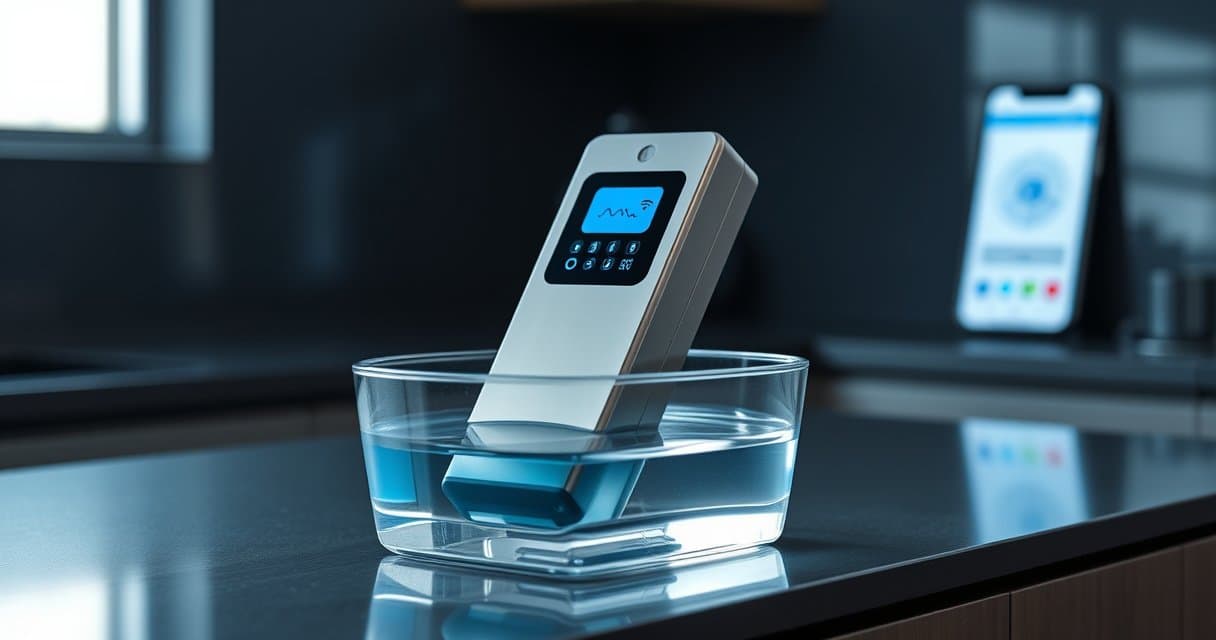
You know how to set a temperature manually. That's the basics. But the real magic, the kind that changes your routine, begins when the appliance thinks along with you. Connectivity and pre-programmed modes aren't just geeky gadgets: they're what transform precise cooking into convenient cooking, especially when life moves fast. For me, it's often what separates a good tool from a better sous vide machine.
Automatic Programs: The Built-in Chef
Turning a knob to select "Fish", "Rare Beef" or "Tender Vegetables" is comfortable. But look at what's behind it. A program worthy of the name doesn't just launch a standard temperature. It manages pasteurization by integrating the necessary holding time for food safety, for example, for chicken cooked at a low temperature. It can offer a two-stage cooking process: one precise temperature for texture, then a short temperature rise for finishing without overcooking. A concrete example? The "Soft-Boiled Eggs" program on a high-end model. It doesn't just heat to 63°C. It follows a protocol that accounts for egg size (M or L) and whether they are taken from the fridge or not, guaranteeing a result every time. That's a useful program: it encapsulates expertise you might not have necessarily researched.
WiFi/Bluetooth Connectivity: Absolute Control and Flexibility
This takes things to another level. Imagine: your beef cut is in the bath, you're at the market, and you can check the core temperature from your smartphone. That's convenient. But where it becomes brilliant is for managing your time.
- Remote Start: You pack your vegetables for Sunday evening meal prep, you place the bag in the cold bath. Monday at 7 am, from your bed, you start the cooking via the app so it's ready when you wake up. No more need to program everything in advance with complicated timers.
- Recipe Libraries and Integrated Guides: Good applications don't just control. They guide you. They suggest temperatures for a flank steak, with notes on texture, and allow you to save your own settings ("My Perfect Christmas Turkey"). It's a valuable memory.
- Alerts and Monitoring: You're doing a 36-hour cook for short ribs? An alert on your phone if the water level drops or the temperature deviates is a real safeguard. It prevents silent disasters.
Is It Worth Paying for These Features?
Frankly, it depends on your profile. If you use your machine once a month for a steak, it's an unnecessary luxury. On the other hand, if sous vide cooking is your primary method for managing weekly meals, for experimenting, or for impressing your guests, these features are no longer a bonus. They become central. They reduce the margin for error, free your attention, and allow you to do things impossible otherwise, like adjusting the cooking time for a leg of lamb from your couch. Their value is measured less by their technicality than by the comfort and peace of mind they provide in daily life. It's an investment in your culinary peace of mind.
Adapt the Machine to Your Budget and Frequency of Use
Choosing a vacuum sealer is like choosing a car. You don't buy a workhorse vehicle for a 2 km daily commute in the city, nor a city car to cross the country every week. You need to align your culinary ambitions with your wallet and your daily reality. The best food vacuum sealer for you is the one that disappears into your routine because it's perfectly suited to it, not the one that gathers dust because it's too complex or too limiting.
Profile 1: The Occasional Curious Cook (1 to 2 times a month)
You want to test the technique, perfect your weekend steaks, or preserve garden surplus? There's no need to aim for the high-end. Look for a simple and robust appliance. Prioritize a basic external aspiration system with a reliable sealing bar. Temperature accuracy? A variance of ±1°C is acceptable for your needs. Connectivity? Forget it, a dial and a button are enough. Your real trap is the cost of consumables. Avoid at all costs machines that lock you into a system of proprietary, expensive bags. Check compatibility with standard smooth and embossed bags, sold in rolls at stores. This is where you'll save money over time. A tip: plan a budget a bit wider than for the appliance alone to invest in quality bags and a good handheld torch for finishing. Otherwise, the experience will be disappointing.
Profile 2: The Regular Enthusiast (1 to 2 times a week)
Here, you're getting to the heart of the matter. The machine becomes a tool for meal prep, preservation, and experimentation. You need to upgrade on specific points. Accuracy should be better (aim for ±0.5°C) for reproducible results. Chamber size matters: if you cook for a family, 10-12 liters becomes a minimum to prepare two dishes in parallel. Advanced functions like a "pulse" mode for fragile foods or a manual sealing button become useful, not superfluous. You will use it often, so noise level and countertop footprint are criteria not to be overlooked. Frankly, in this category, you shouldn't cut corners too much. A well-designed €150 machine will serve you better and longer than a budget model that will limit you and end up causing frustration.
Profile 3: The Demanding Intensive User (almost daily)
For you, it's a piece of production equipment. Whether you're prepping your weekly meals, regularly going on trips with your family, or are a precision cooking enthusiast, the machine must be infallible and efficient. The criteria become strict:
- Accuracy: ±0.1°C is not a luxury, it's a necessity for very long cooks or for competitive results.
- Circulation Power: It must maintain a perfectly homogeneous temperature in a large volume of water, even when you open the lid.
- Robustness: We're talking thousands of hours of operation. The materials and finish must be up to the task. Connectivity (Wi-Fi) moves from being a gadget to an essential monitoring tool for your 24 or 48-hour cooks. The ability to use large containers (20L or larger bins) is often decisive. At this level, the entry price is higher, but it is justified by unmatched durability and reliability. It's a long-term investment for your culinary practice.
Conclusion
The right choice of a vacuum sealer is one that fades into the background, making way for your cooking.
Identify your real needs. Balance the initial investment with the cost of use. Do not be seduced by functions you will never use.
It is by aligning precision, capacity, and practicality with your own rhythm that this tool will become indispensable. It's no longer just about preservation, but about culinary freedom.
The ball is in your court.
Frequently Asked Questions
What is the best vacuum sealer for daily use?
For regular use, aim for an external vacuum sealer with a pulse mode, a thermal precision of at least ±0.5°C and a power of 1000-1200W for stable cooking in a 10-12 liter container, which is ideal for family meal preparation.
Should I choose an external vacuum sealer or a chamber vacuum sealer?
Choose an external vacuum sealer for mainly sealing solid foods like meats and vegetables, as it is more compact and economical. Opt for a chamber vacuum sealer if you frequently seal liquids like soups or marinades, or for intensive meal preparation.
What thermal precision is needed for sous vide cooking?
A precision of ±0.5°C is sufficient for most daily cooking of meats and vegetables. A precision of ±0.1°C is necessary for competition-level results or very long cooks (24-48h), where perfect stability is essential.
How to choose the capacity and power of a sous vide cooker?
Ensure the power (in watts) matches your container's volume: plan for 1000-1200W for up to 18 liters and at least 1500W for volumes over 20 liters, to guarantee fast heating and an even temperature.
Is connectivity useful on a sous vide cooker?
Connectivity (Wi-Fi/Bluetooth) is a convenient tool for starting or monitoring a cook remotely, but it is mainly useful for intensive users managing long cooks. For occasional use, simple manual controls are often sufficient.
100% free and independent — All our articles are written independently, without any sponsorship. We may earn a commission on purchases made through our links, at no extra cost to you.
Guides you might like
Bell Jar Vacuum Sealer Buying Guide
Upgrade to a chamber vacuum sealer for professional sous-vide results at home. Perfect for liquids and flawless, long-lasting seals.
Best Beginner Sous Vide Kit
Find the perfect sous-vide starter kit on a budget. Learn the three essential features to look for to cook your first perfect steak without the headache.
Best Vacuum Bags
Choose the right vacuum sealer bags for perfect results. Learn key specs like heat resistance, thickness, and barriers to avoid culinary disasters.
Articles you might like
Lipavi C10 11.3 Liter Vacuum Container Review & Test
LIPAVI C10 sous-vide container review: analyzing its energy efficiency, thermal stability & ease of use for precision cooking.
DOQAUS Instant Read Dial Thermometer Review
Master temperature for perfect cooking. Dial thermometer for instant, reliable readings on steak, syrup, ovens. Essential precision tool.
Dictien CF-001A 6-in-1 Sous Vide Machine Review
Ensure perfect sous-vide with the versatile Dictien CF-001A 6-in-1 vacuum sealer for both dry and moist foods. A comprehensive review.