The Ultimate Dehydrator Guide
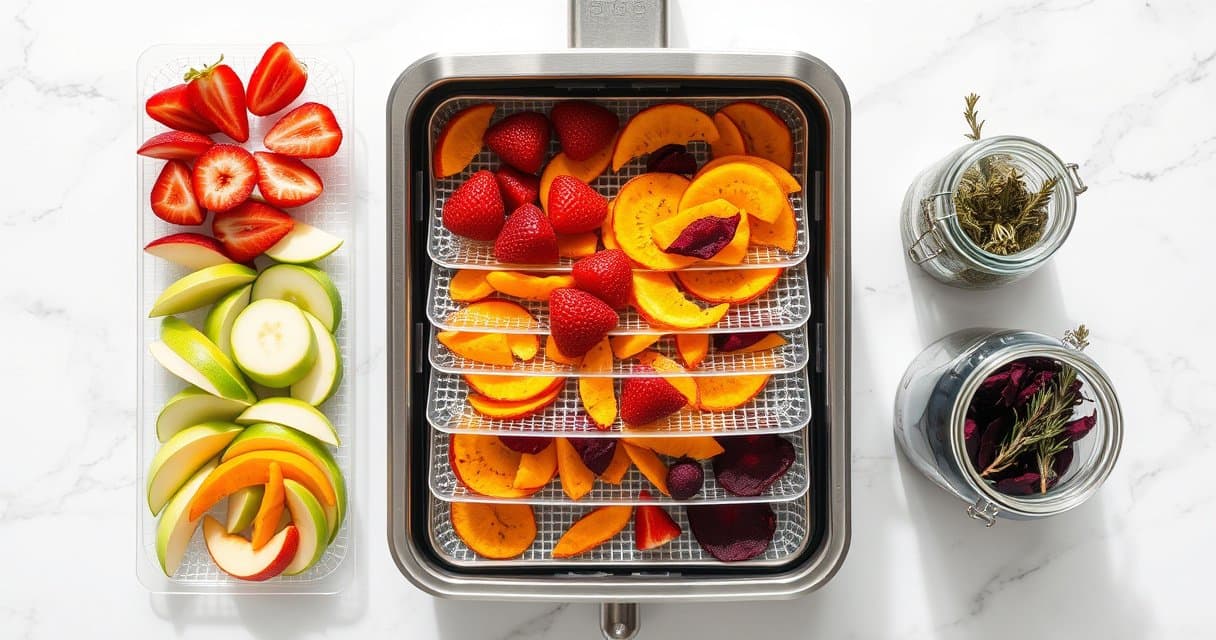
Imagine a pantry filled with jars, overflowing with summer fruits, wild mushrooms, and aromatic herbs, captured in full sunlight. It sounds like a dream, but it's the tangible reality offered by a dehydrator: a kitchen tool that radically transforms your relationship with food. Frankly, if you love cooking with precision and dread waste, this appliance should already be on your counter. Let's see together how to choose the right one.
Key Points to Remember
- A good dehydrator is first chosen based on its intended uses, requiring a precise temperature range (35°C to 70°C) to dry everything, from delicate herbs to jerky.
- Mastery of dehydration relies on two essential technical criteria: stable temperature and uniform air circulation for consistent results without constant supervision.
- The motor's power must be proportional to the appliance's capacity, and details like tray materials or noise level greatly impact the comfort of use.
- Integrating the dehydrator into your routine, for example with overnight cycles, is key to making it a regular tool and preventing it from gathering dust.
- Final success depends on meticulous preparation (uniform cuts, pre-treatments) and impeccable storage in airtight containers, protected from humidity.
Deciphering Uses: From Healthy Snacks to Long-Term Preservation
This is where everything happens. Before looking at a single model, ask yourself this very simple question: "But what will I actually be able to do with it?" The answer goes far beyond simple dried apples. This appliance is a true Swiss army knife for preservation and culinary creativity. We often think of fruits, but the possibilities are almost endless.
The Zero-Waste Pantry
Has your fennel lost its luster? Are your tomatoes about to go bad? The dehydrator is the ultimate anti-waste solution. It's not just about "saving" food, but about elevating it for future use. For example, cherry tomatoes cut in half and dried at 60°C for 8 to 10 hours become umami bombs to add to your sauces, soups, or homemade pizza. Carrot or radish tops, finely chopped and dried at a low temperature (around 40°C), transform into a homemade seasoning, much tastier than any store-bought blend. It's a philosophy: to value every part of your produce.
The Homemade (and Healthy) Snack Factory
This is often the starting use. No more bags of dried fruit loaded with added sugar and oils. You take back control. Slices of mango, banana, or pineapple dried at 50-55°C make a naturally sweet and much more economical snack. But don't stop there. Try "fruit leathers": blend strawberries with a touch of lemon, spread the puree thinly on a fruit leather sheet, and dehydrate. The result? An addictive and healthy treat, perfect for kids. On the savory side, vegetable chips (beetroot, sweet potato, kale) are a revelation. A bit of olive oil, some spices, and you're done. You have total control over the raw materials, seasonings, and texture. That's true freedom.
For Charcuterie and Plant Enthusiasts
This is where it gets serious, and your choice of machine becomes crucial. Preparing dried meats like "jerky" requires a precise and consistent temperature, generally between 65°C and 70°C, to ensure absolute safety and perfect texture. A fluctuation of a few degrees can ruin everything. Similarly, for aromatic herbs, edible flowers, or "living foods" you wish to preserve with their enzymes intact, you need a low range, ideally starting at 35°C. A model that doesn't go below 45°C will literally burn the delicacy of your basil or rosemary. A true food dehydrator worthy of the name must be able to juggle between these two extremes.
The Creative Culinary Workshop
Finally, if you love to experiment, the appliance opens up an incredible field of possibilities. Make your own onion, garlic, or mushroom powders for instant sauces. Try raw crackers made from sprouted seeds and vegetables. Prepare fruit pastes for pastries, or even fermented plant-based "yogurt" dehydrated into powder. It's an investment that evolves with you. Frankly, if you're only considering apple rings, look elsewhere. But if the idea of creating your own gourmet pantry, additive-free and with incomparable flavor, makes you dream, then you're in the right place.
The Critical Importance of Temperature and Air Circulation
This is the heart of the matter. Choosing a dehydrator is choosing a control tool. And this control boils down to two elements: heat and air movement. One without the other leads to nothing good. It's the precision on these two points that distinguishes a basic appliance from a true, reliable kitchen partner.
The Temperature Range: Your Ultimate Control Lever
Temperature isn't just a knob to turn. It's the parameter that decides whether you preserve or destroy. Imagine you want to dry fresh mint for your tea. If your appliance doesn't go below 50°C, you will cook the leaves, making them lose their vibrant color and subtle aroma. They will turn brown and lifeless. For that, you need a range that starts low, ideally at 35°C or 40°C.
Conversely, to safely dry beef jerky, you need to go up to around 70°C to quickly eliminate any bacterial risk. An extended range from 35°C to 70°C (or even 75°C) is therefore crucial. But watch out for precision! A digital display is a good indicator, but what matters is real stability. A model with regulation to the degree and minimal fluctuation (±1°C) is a mark of quality. A drying cycle at 55°C that actually fluctuates between 50 and 60°C will yield uneven results, with some parts soft and others too dry. Frankly, on this point, you shouldn't compromise.
Air Circulation: The Secret to Uniformity
This is the other half of the equation, and too often underestimated. You can have the perfect temperature, but if the air doesn't circulate well, you'll be playing tray puzzle every two hours. The goal is simple: that every apple slice, on every tray, dries at the same speed.
There are mainly two designs. Models with rear or side fans blow air horizontally. The risk? The air loses strength as it passes through the trays, and the ones at the back dry slower than those at the front. You are forced to swap and rotate the trays manually. It's tedious.
Models with vertical air circulation (a fan at the bottom or top that circulates air from bottom to top or vice versa) promise better homogeneity. In theory, the air passes through each tray the same way. But here again, everything depends on the motor's power and the design of the vents. A fan that is too weak won't manage to push the hot air to the last tray. For a 10-tray appliance, a power of 500W will be much more effective than a 250W model, for example. This is what allows an 8-hour drying cycle to proceed without you having to touch it. It's a convenience that changes everything, especially for overnight drying.
The Winning Duo: Precision + Homogeneity
When these two elements are mastered, magic happens. Take a concrete example: button mushrooms sliced thinly. You spread them over 5 trays. You set it to 50°C to preserve their earthy flavor. Thanks to stable temperature and optimal air circulation, all the slices will be crispy and dry at the same time, after, let's say, 6 hours. No soft spots, no waste. You get a perfect product, ready to be stored for months in a jar.
It is this alliance that defines a good appliance. This is also why very cheap models, with a simple heating element and a small fan, will frustrate you quickly. They do the job, but without finesse. If you really want to explore the full potential of dehydration, from delicate herb powders to impeccable dried meats, investing in a dehydrator that excels on these two fronts is non-negotiable. It is the only way to get professional results, batch after batch.
Our Selection
Choosing the right food dehydrator can be tricky given the vast array of options. Between capacity, materials, power, and practicality, the selection criteria are numerous. In this selection, we analyze three popular models on paper and based on community feedback, to help you see more clearly.
| Product | Power | Tray Materials | Key Features | Strengths Based on Reviews |
|---|---|---|---|---|
| DeeprBling | 160W | 5 PP trays (BPA Free) | 48h timer, digital display, very quiet (≤25dB) | Remarkable quietness, ease of use |
| H.Koenig DSY700 | 380W | 5 transparent plastic trays | 24h timer, A+ energy class, 2-year warranty | Good value for money, fast drying speed |
| YASHE | 400W | 5 stainless steel trays | 48h timer, automatic stop, 180° rotating tray | Easy cleaning, robust construction |
DeeprBling Food Dehydrator
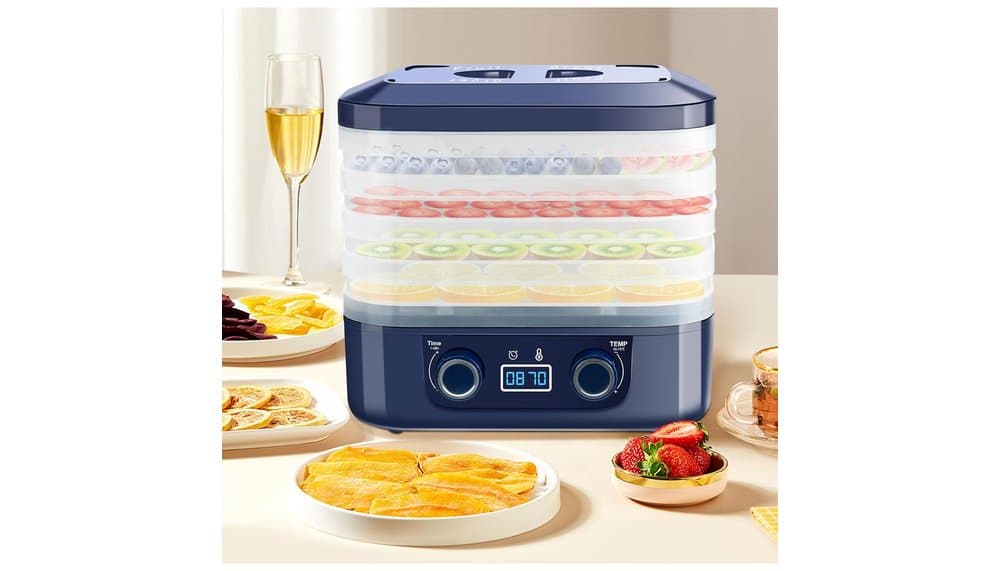
On paper, the DeeprBling positions itself as a very quiet and simple appliance, ideal for continuous use without noise nuisance. Its specifications announce an operating noise of less than 25 decibels, which is notable for a kitchen appliance. The presence of a timer programmable up to 48 hours and a digital display with touch control promises precise and intuitive use.
According to user feedback, its main confirmed asset is indeed its quiet operation, appreciated for long drying cycles, even overnight. The 360° air circulation seems to ensure relatively uniform drying across all 5 trays. However, reviews highlight two important limitations. First, its 160W power is the lowest in our selection. Users note that the dehydration process can be longer, especially for meats or fleshy fruits. Secondly, although lightweight and stackable, the PP plastic trays, while BPA Free, can warp over time according to some comments. It is therefore a model that will perfectly suit those who prioritize silence and occasional use for fruits, herbs, or vegetables, but which might lack vigor for intensive use on foods with high water content.
H.Koenig DSY700
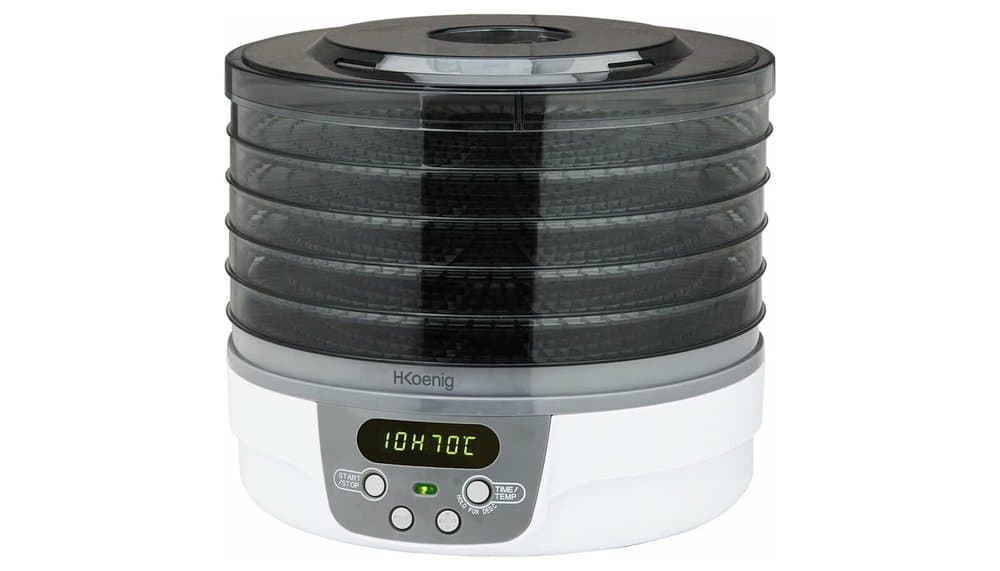
The H.Koenig DSY700 is a veteran in comparisons, with a large number of customer reviews that allow for an accurate profile. On paper, its assets are high power (380W), an A+ energy class, and a 2-year manufacturer's warranty with a workshop in France, a mark of seriousness. Its cylindrical design with 5 transparent trays offers good visibility of the drying progress without having to open the appliance.
The community largely confirms its strengths: its power allows for faster drying than many of its competitors in this range, which is frequently cited as a decisive advantage. Users also appreciate its good value for money and its general reliability in the medium term. On the other hand, reviews also point out concrete limitations. First, despite its performance, it is described as louder than other models, which can be a drawback for use in a living space. Secondly, the timer is limited to 24 hours, which can be tight for some preparations like beef jerky that sometimes require longer cycles. Finally, its cylindrical shape is less compact than a rectangular design for storage. It is clearly the choice for efficiency and speed, for those who are willing to accept a bit more noise and whose drying time needs do not exceed a day.
YASHE Food Dehydrator
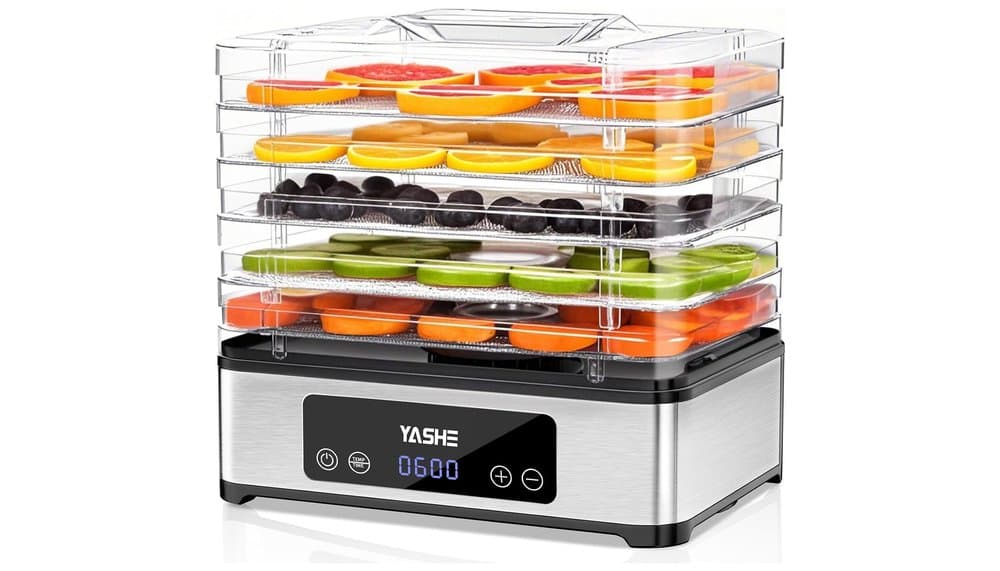
The YASHE immediately stands out due to its stainless steel construction for the trays and base, promising robustness and ease of maintenance. With 400W of power and a timer up to 48h with automatic stop, its technical specifications are complete. The 180° tray rotation function is interesting for adjusting space based on food thickness.
Community feedback validates several of these promises. The stainless steel trays are unanimously praised for their sturdiness and the fact they are dishwasher safe, a real practical plus. The power is considered sufficient for most tasks, ensuring effective drying. However, some users note that the airflow, although presented as 360°, can be less uniform at the edges of the trays, sometimes requiring food to be turned halfway through the cycle. Furthermore, at 1.9 kg, it is the heaviest appliance in the selection. It is therefore a model that will appeal to those for whom durability and ease of cleaning are paramount, and who are willing to supervise the process a bit more for a perfect result.
Choosing the Right Specifications: Power, Capacity, and Design
It's time to look under the hood. Temperature and air flow, that's the theory. But how do these promises translate into the machine? This is where we talk about numbers, centimeters, and watts. Don't worry, it's simpler than it seems.
Motor Power: Don't Just Trust the Number
You often read "500W" or "350W" in big letters on the box. The higher the number, the better, right? Not so fast. Power is like a car's engine size. High power (let's say 600W) can enable faster drying and efficient heating, especially if you fill the appliance to the brim. But it also consumes more electricity. The trick is to link it to capacity.
A 250W motor for 4 small trays can be perfectly adequate. The same motor for 10 large trays? It will struggle, air circulation will be poor, and drying will take forever. Look for a balance. For a family-sized model (8-10 trays), aiming for 400W to 600W is a good compromise between performance and relative efficiency. A powerful, well-designed motor also often means durability: it doesn't overheat and can run for 24 hours straight without a hitch.
Capacity and Size: The Space Question
Here, you need to be very pragmatic. Manufacturers talk in number of trays, but a tray is not a standard unit! A 30 cm diameter tray is nothing like a 40 cm square tray. Always look at the total usable surface area. To give you an idea: to dry 2 kg of sliced apples, you'll easily need 4 to 5 large trays.
Ask yourself two simple questions:
- Where will I store it? A 10-tray dehydrator is often the size of a large microwave oven. Do you have that space in a cupboard or on a dedicated countertop?
- Will I often use it at full capacity? If it's for making chips from 2 beets once a month, 5 trays are enough. If you plan to turn 5 kg of tomatoes from your garden into powder, or prepare jerky for the whole family for the week, opt for an expandable model (you can add trays) with at least 9-10 trays. Frankly, it's more frustrating to have an appliance that's too small than too big.
Design: The Details That Make a Difference Day-to-Day
This is where the enjoyment (or chore) of using it comes into play. Keep an eye out for these points:
- Tray Materials. BPA-free plastic is common, but some models offer stainless steel mesh trays. It's an investment, but they are scratch-resistant, easier to clean of sticky preparations (like very ripe fruit or fruit puree for leathers), and don't retain odors. A real plus.
- Tray Flexibility. Some are fixed, others have removable grids from a frame. The latter are great for herbs or small fruits that might fall through. You can also use them to make "bars" of dried fruit by spreading a puree directly onto a flexible silicone sheet, often included.
- Controls and Timer. A digital display with degree-by-degree settings and a programmable timer that stops by itself is a monumental convenience. No more watching the clock! You program it in the evening, and in the morning, it's ready. Compare that to a simple mechanical rotary knob... the choice is quickly made for serious use.
- Noise. Often overlooked, but crucial. A dehydrator can run for 12 to 24 hours. A constant 60 dB hum (like a conversation) in your kitchen open to the living room quickly becomes annoying. The best models incorporate sound insulation and optimized fans to be more discreet, around 40-50 dB (a bit more than a fridge). For overnight drying, this is non-negotiable.
Integrating the Dehydrator into Your Routine (and Your Space)
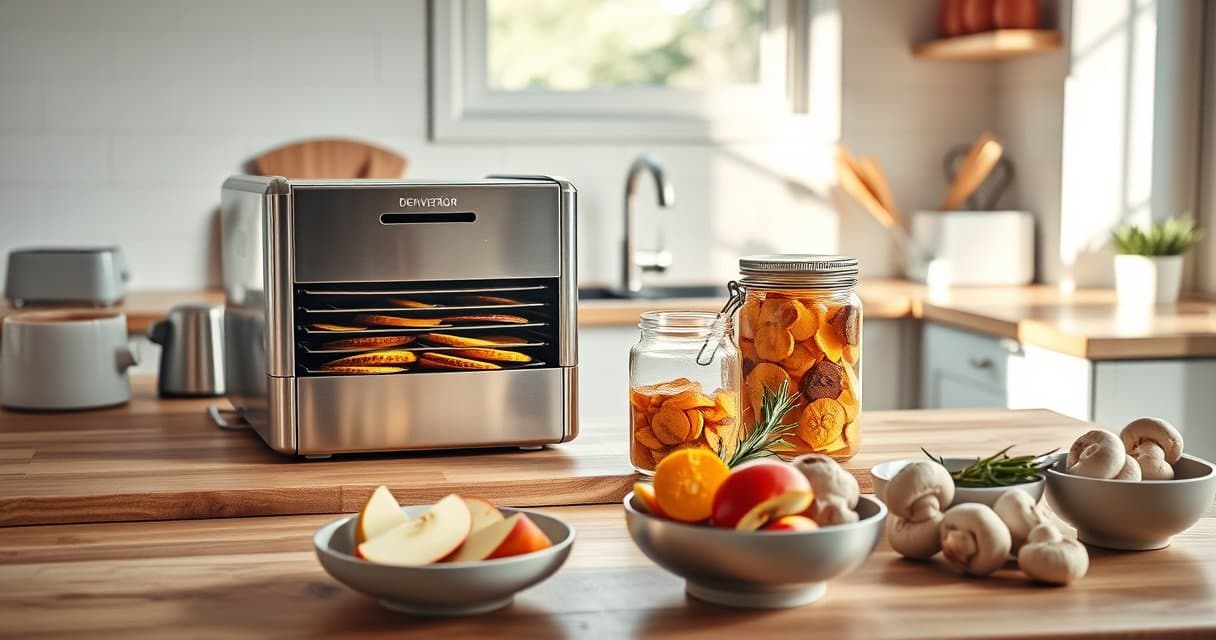
You have the perfect appliance in mind? Great. Now, the real question is: will it truly find its place in your daily life? Because between the dream of homemade sun-dried tomatoes and the reality of a machine running for 18 hours on the countertop, there's a gap. Let's make sure it's easy to bridge.
The Art of Timing: Syncing Drying with Your Schedule
A dehydrator is not an oven. You don't use it for an immediate meal. It's a background tool, a silent transformer. And that's a strength. You need to think in "production cycles." Here's how I do it, for example:
- The Night Cycle: It's my favorite. In the evening, after dinner, I prepare my apples, mushrooms, or herbs. I start the program. The discreet appliance works while everyone sleeps. By breakfast, it's ready. It's magical.
- The Weekend Marathon: For large quantities (a fruit harvest, a batch of jerky for the week), I start it on Saturday morning. It runs all day in a corner of the kitchen. The smell is divine, and by Sunday, everything is packed.
The key is to anticipate. Consider it a slow but very effective member of your culinary team. Plan your drying sessions like you plan your weekly menus.
The Impact on Your Space: More Than Just Size
Yes, it's bulky. But you can be smart about it.
- Permanent Storage: If you have dedicated counter space (a central island, a section of counter in the laundry room), it's ideal. You can plug it in and leave it in place. Then think about its design: does it need to be presentable?
- Mobile Storage: If not, it needs to be mobile and not too heavy. Check its empty weight. A model with sturdy handles is a must. Where will you store it? In a low cabinet? On a high shelf? Measure the space before buying, with a 5 cm margin for easy removal and storage.
- The Power Outlet: It seems silly, but check the length of the power cord. Is there an easily accessible outlet where you plan to place it? Nothing is more annoying than having to use a bulky power strip for an appliance that stays plugged in for hours.
Uses That Go Beyond Fruit
To keep it from gathering dust, discover its hidden potential. That's where the magic happens.
- Your Homemade Yogurt: With a dehydrator that goes down to 40-42°C, you have a perfect incubator, much more stable than a classic yogurt maker. Fill jars, place them on the trays, and let the gentle heat do its work. The result is incredibly creamy.
- Sourdough Starter and Herbs: Dry surplus sourdough starter to preserve it, or make your own powder of garlic, onion, bell pepper, mushroom. The flavor is a hundred times more powerful than store-bought powders, without anti-caking agents.
- Fruit "Leathers": Blend fruits (strawberry-mango is delicious), spread the puree thinly on a silicone mat, and dehydrate. You get a kind of flexible fruit sheet, perfect for kids' snacks or hikers. A great way to use up overripe fruit.
In short, the best food dehydrator for you isn't just the one with the right specs. It's the one that, through its ease of use and versatility, naturally fits into the flow of your kitchen. It should become a given, not a chore. If you have to retrieve it from a garage cabinet and mount an expedition to use it, it will inevitably end up neglected. Choose it also for the daily life it will enable you to create.
Mastering the Technique: Preparation, Monitoring, and Optimal Storage
The machine is running? Great. Now it's your turn. Because even the best food dehydrator in the world won't compensate for poor preparation or careless storage. This is where the quality of your finished products is determined. Let's get down to business.
Cutting and Pre-Treatment: The Secret to Uniformity
It all starts at the cutting board. Thickness is the golden rule. Slices of 3 to 5 mm are ideal for most fruits and vegetables. Thinner, they become brittle; thicker, drying takes forever. An adjustable mandoline is your best ally here – frankly, trying to cut everything with a knife is a guarantee of uneven results.
For some foods, a little pre-drying boost works wonders:
- Fruits that brown (apples, pears, bananas): a 5-minute bath in a mixture of water and lemon juice (1 tablespoon of juice to 250 ml of water) blocks oxidation.
- Vegetables with thick skins (tomatoes, peppers): quick blanching (30 seconds in boiling water, then a shock in ice water) helps preserve color and speeds up drying.
- Meats for jerky: always cut with the grain if you want tender strips, and against the grain for a more brittle result. Marinating for at least 4 hours (soy sauce, spices, a bit of honey) is essential for flavor and texture.
Monitoring During Drying: Patience and Observation
Put your timer aside. The time indicated in recipes is a guide, not a law. Too many variables come into play: the thickness of your slices, ambient humidity, tray load.
The real technique is the break test. Towards the end of the estimated time, take out a piece and let it cool completely. Bend it.
- For fruits, it should be pliable and leathery, with no damp or sticky spots in the center.
- For vegetables and meats, it should be brittle and dry. If in doubt, continue drying for one more hour. Better a little too dry than not enough.
An insider tip: note your parameters! Temperature, slice thickness, final time. After a few tries, you'll have your own foolproof references.
Storage: Sealing Success for Good
This is the most critical step, where everything can be ruined. A poorly stored product will soften, mold, and all your efforts go to waste.
The absolute rule is cold packaging. Never put your still-warm dehydrated foods into jars. Let them rest in the open air on the counter for an hour. They must be at room temperature.
Then, choose your weapons:
- Glass jars with seals (like Le Parfait): perfect for herbs, fruits, vegetables. Opaque is even better.
- Vacuum-sealed bags: the pro option, especially for meat. The total absence of oxygen guarantees storage for several months, even a year. If you have a vacuum sealer, it's the best.
- Airtight containers: practical, but check the seal carefully.
And the last secret, often ignored? The conditioning test. After 24 to 48 hours of storage, open a jar and check for condensation on the lid. If yes, it means the residual moisture is too high. You need to put the food back in the dehydrator for an hour or two. This little check will save you a lot of trouble.
Conclusion
Dehydration is not just a technique. It's a freedom.
The freedom to capture a season in a jar. The freedom to create pure snacks, with no added sugar or preservatives. The freedom to never again throw away a forgotten vegetable at the back of the drawer.
By mastering temperature, airflow, and these preparation steps, you are not just drying food. You are building a personal reserve of flavors, nutrients, and self-sufficiency.
Start simple, with apples or herbs. Observe, note, taste. Your kitchen has just gained a new dimension, precise and deeply rewarding. Happy exploring.
Frequently Asked Questions
What is the best dehydrator for making jerky?
The best dehydrator for jerky must offer precise and stable temperature control around 65°C to 70°C to ensure food safety and perfect texture, with even air circulation for uniform drying.
How to choose a dehydrator for aromatic herbs?
To dry aromatic herbs without burning them, you need a dehydrator capable of reaching a low temperature, ideally 35°C or 40°C, and not a model with a minimum of 45°C or higher.
What motor power for a family dehydrator?
For a family dehydrator with 8 to 10 trays, a motor power between 400W and 600W offers a good balance, ensuring efficient air circulation without excessive electricity consumption.
How to store dehydrated foods for a long time?
For optimal preservation, dehydrated foods should be packaged cold in airtight glass jars or vacuum-sealed bags after being fully cooled at room temperature.
Can a dehydrator replace a yogurt maker?
Yes, a dehydrator with a precise low-temperature range (around 40°C to 42°C) can perfectly serve as a yogurt incubator, often offering superior stability compared to a classic yogurt maker.
Should fruits be pre-treated before dehydrating?
Some fruits require pre-treatment: a lemon juice bath to prevent browning of apples or pears, and a quick blanching for thick-skinned vegetables like tomatoes.
100% free and independent — All our articles are written independently, without any sponsorship. We may earn a commission on purchases made through our links, at no extra cost to you.
Guides you might like
Bell Jar Vacuum Sealer Buying Guide
Upgrade to a chamber vacuum sealer for professional sous-vide results at home. Perfect for liquids and flawless, long-lasting seals.
Best Beginner Sous Vide Kit
Find the perfect sous-vide starter kit on a budget. Learn the three essential features to look for to cook your first perfect steak without the headache.
Best Vacuum Bags
Choose the right vacuum sealer bags for perfect results. Learn key specs like heat resistance, thickness, and barriers to avoid culinary disasters.
Articles you might like
Lipavi C10 11.3 Liter Vacuum Container Review & Test
LIPAVI C10 sous-vide container review: analyzing its energy efficiency, thermal stability & ease of use for precision cooking.
DOQAUS Instant Read Dial Thermometer Review
Master temperature for perfect cooking. Dial thermometer for instant, reliable readings on steak, syrup, ovens. Essential precision tool.
Dictien CF-001A 6-in-1 Sous Vide Machine Review
Ensure perfect sous-vide with the versatile Dictien CF-001A 6-in-1 vacuum sealer for both dry and moist foods. A comprehensive review.