The Sous Vide Immersion Circulator Guide
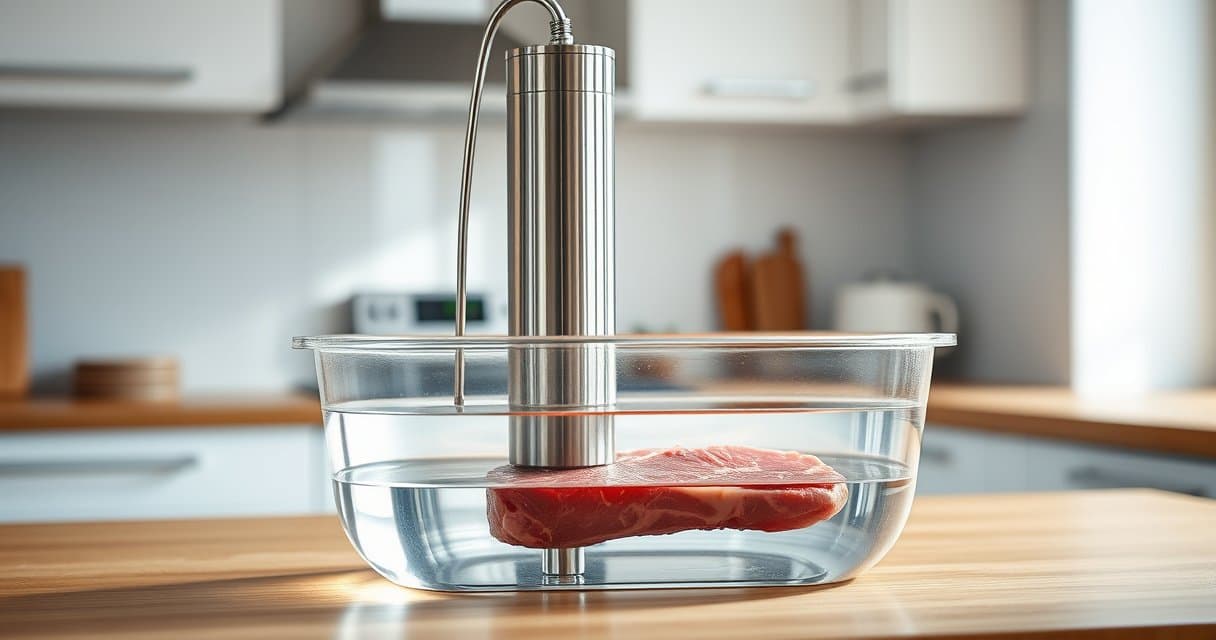
It's dinner time and your steak is overcooked on the outside, still cold in the center? The sous-vide immersion circulator is the elegant solution to this classic problem. More than just a gadget, it's the tool that gives you absolute control over cooking, guaranteeing perfect results every time, whether it's a tender midweek chicken or a melting roast leg for entertaining. Frankly, once you adopt it, you'll never cook the same way again.
Key Takeaways
- A minimum power of 1100W and an accuracy of ±0.1°C are essential for perfect and reproducible results.
- IPX7 waterproofing and an integrated circulation pump are non-negotiable features for safety and cooking uniformity.
- The choice of container volume (18-22L is the most versatile) and sealing method (chamber sealer for liquids) is strategic for efficiency and budget.
- High-temperature finishing (pan, torch, grill) after the bath is essential for creating the crust and enhancing flavors.
Core Criteria: Power, Precision, and Durability
One might think a sous vide immersion circulator is just a heating element in a water bath. A serious mistake! The differences between models come down to three concrete pillars that make the difference between a merely good result and a chef's success, infinitely reproducible. Let's focus on the essentials.
Power: For Thermal Shock, Not Just Heating
Power, expressed in watts (W), is often misunderstood. It's not just there to heat the water, but to heat it fast and, above all, to keep the temperature perfectly stable when you immerse a cold food item. Imagine placing a large 2 kg roast straight from the fridge into a bath at 58°C. That's a real thermal shock!
For serious use, aim for a minimum of 1100W. An 800W model will struggle to recover from the temperature drop, lengthening the actual cooking time and potentially even compromising food safety with large cuts. For a 20 to 30 liter container, a power of 1200W to 1500W is ideal. This guarantees a rapid temperature rise (think 30 to 40 minutes to bring 20 liters to 75°C) and responsive regulation. Frankly, saving 50€ on an underpowered model is condemning yourself to frustration during important cooks.
Precision: The Heart of the Science
This is the most crucial point. Precision is the device's ability to reach and maintain the temperature you've set. A margin of ±0.1°C is not a marketing luxury; it's the guarantee that your salmon will always be perfectly pearlescent at 44°C and your flank steak always as tender at 55°C. Some entry-level models boast an accuracy of ±1°C, even ±2°C. On paper, that seems small. In practice, it's the difference between a creamy egg yolk and an overcooked one, or between a tender sirloin and a rubbery one.
For red meats and eggs, this microscopic precision is non-negotiable. It's what makes the difference between a decent device and the best sous vide immersion circulator for your practice. Always check this specification in the technical sheet; it's more important than the number of pre-programmed settings!
Durability: Waterproofing Above All
A device that lives on the edge of a bath of hot water and steam must be built for it. The absolute criterion is the IPX7 protection rating. This means the device can be temporarily immersed in one meter of water without damage. In short, you can rinse it under the tap after use without worry. Never buy a model without this certification; it's an unnecessary risk.
The second point is construction. Prioritize a shaft and main body made of food-grade stainless steel. Avoid low-grade plastics on the hot parts, which can warp or release odors. A good device is heavy, stable, and the clip for attaching it to the edge of the container is solid. After all, it might run for 24 hours straight for pulled pork: reliability is key.
Water Circulation, Volume, and Integration in Your Kitchen
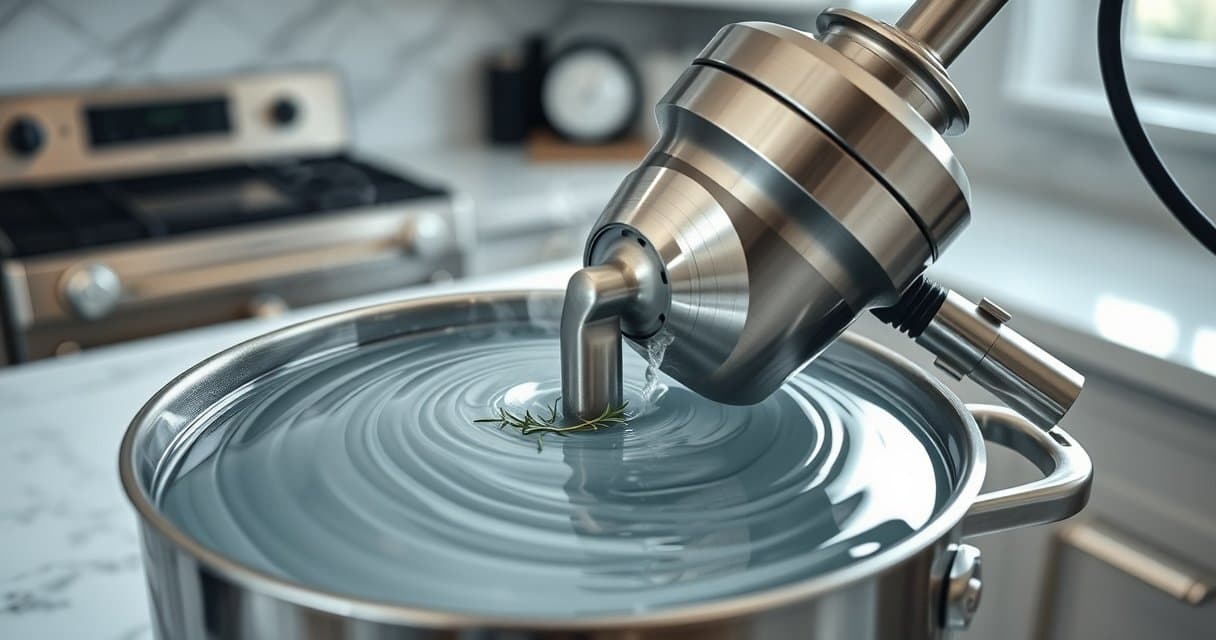
Your immersion circulator is a marvel of technology, but if it simply pours hot water into a corner of your container, you will have cold spots and uneven cooking. Circulation is the art of creating a uniform bath. And for that, you need to think about the entire system: the pump, the container, and how all of this will fit into your space.
The Pump: Discreet but Essential
Forget the idea of simple static heating. An integrated circulation pump is non-negotiable. It constantly stirs the water, eliminating cold pockets and ensuring that every millimeter of your food receives the same temperature. For long cooks of 12 to 48 hours, this is what guarantees safety and repeatability.
There is, however, a nuance: flow rate and noise. A low flow rate (around 8 liters per minute) may suffice for a small volume, but for a 30-liter container or more, aim for 12 L/min instead. As for noise, listen to online demos if you can. Some models emit a slight continuous hum, others a regular clicking sound. For a cook that can last all night in your open-plan kitchen, this is a criterion not to be underestimated. Frankly, a constant purr is often less annoying than an unpredictable "clack-clack" every two minutes.
Volume and Container: A Strategic Choice
The question is not "what is the largest capacity?" but "what will I really use it for?" An immersion circulator with a 40 cm shaft can heat 40 liters of water, but if you only cook one or two steaks in a small pot, you will waste energy and preheating time.
Ask yourself these questions:
- Solo / duo cooking: A 12 to 16 liter stockpot is largely sufficient. A 25-30 cm shaft is perfect.
- Family meals / meal prep: Here, you're aiming for a 20 to 30 liter polycarbonate container. Check that your appliance's shaft is long enough (often 35 cm and more) to be well immersed and stable.
- Large cuts or parties: For a whole leg of lamb or several kilos of meat, a 40+ liter container is necessary. Make sure the power (at least 1500W) and shaft length are adequate.
My advice? Don't overdo it. An 18-22 liter container is the most versatile for most people. Cover it with food-grade polypropylene ping-pong balls to reduce evaporation and heat loss during long cooks. It's simple and devilishly effective.
Integration in the Kitchen: The Logistics of the Bath
This is the point we always forget. Where are you going to place this 20-liter container for 24 hours? On the countertop, it blocks precious space. Plan for a dedicated spot, possibly on a board placed over the sink for more stability. Also think about draining: a drain valve on the container is an invaluable luxury, otherwise you'll have to lift it, heavy and hot, to empty it into the sink.
Finally, the power cord. Is it long enough to reach an outlet without crossing a walkway? Nothing is more annoying than a precarious setup. Take five minutes to visualize the actual installation. It's often at that moment you realize that a more compact, but equally powerful, model would be the best sous vide immersion circulator for your kitchen, not for the cooking YouTuber's kitchen.
Our Selection
Today we invite you to dive into the heart of home sous-vide cooking with a selection of three immersion circulators. These devices all promise formidable precision for perfect meats, flavorful vegetables, and chef-level soft-boiled eggs. But between ease of use, robustness, and advanced features, their profiles are distinct. Here is our analysis based on their technical specifications and feedback from the user community to help you see things more clearly.
| Product | Power & Flow Rate | Construction | Temperature Management | Key Strengths / Positioning |
|---|---|---|---|---|
| Wancle Vacuum Cooker | 1100W / Flow rate unspecified | Plastic and stainless steel | 25-90°C, precision ±0.1°C | Compact and simple, ideal for small kitchens |
| KitchenBoss G300T | 1100W / ~16 L/min | Full SUS304 stainless steel (impeller + immersed body) | 40-90°C, active stabilization | Premium robustness and quiet operation, with built-in recipe menu |
| KitchenBoss G310 (Silver) | 1100W / 16 L/min | Full SUS304 stainless steel (immersed part) | 40-90°C, precision ±0.3°C | Excellent value for performance, accessible high-end approach |
Wancle Vacuum Cooker
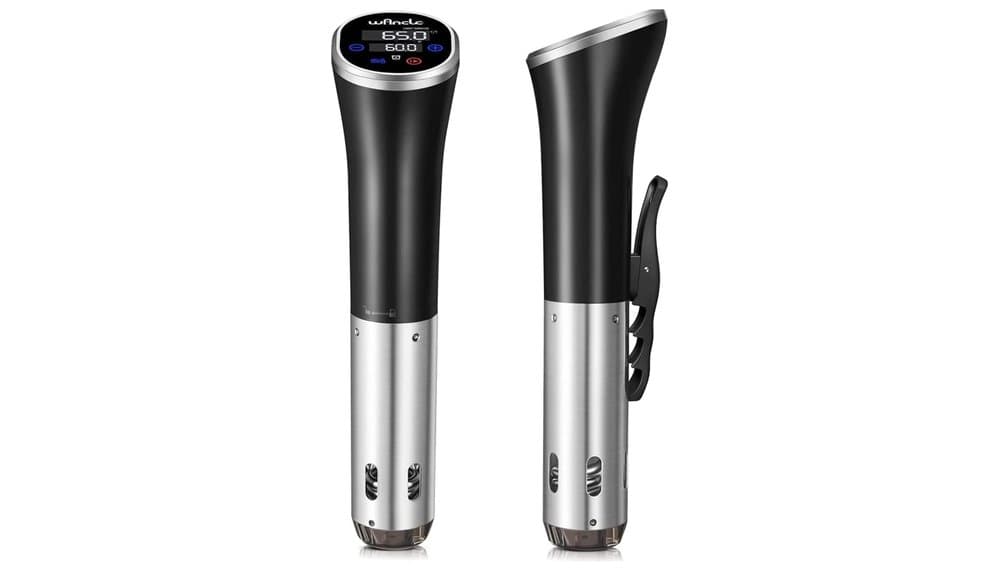
The Wancle Vacuum Cooker positions itself as the most compact and simple option in this selection. Weighing only 730 grams with a design made for storage, it clearly targets users with limited counter space or those who want an appliance that's easy to take out and put away. Its technical specifications claim a 1100W power for fast heating and a control precision of ±0.1°C, which, on paper, is very competitive.
According to user feedback, its main advantages are confirmed: its tilted touch screen is considered very readable and intuitive, and its adjustable clamp fits firmly onto a wide variety of containers. The timer with delayed start function is also appreciated for preparing meals in advance. The overall rating of 4.4/5 based on over 1200 reviews indicates widespread satisfaction for everyday use.
However, analysis of the feedback highlights a few limitations. The construction, although solid, uses plastic for part of the housing, which may seem less premium than all-stainless steel models. Some users with a large pot or preparing large volumes note that the water circulation flow rate isn't the most powerful on the market, which could theoretically affect perfect temperature uniformity in very large containers. Finally, although waterproof (IPX7), its design isn't specifically geared towards noise reduction, a point on which other models in the selection seem to have worked more specifically.
KitchenBoss G300T
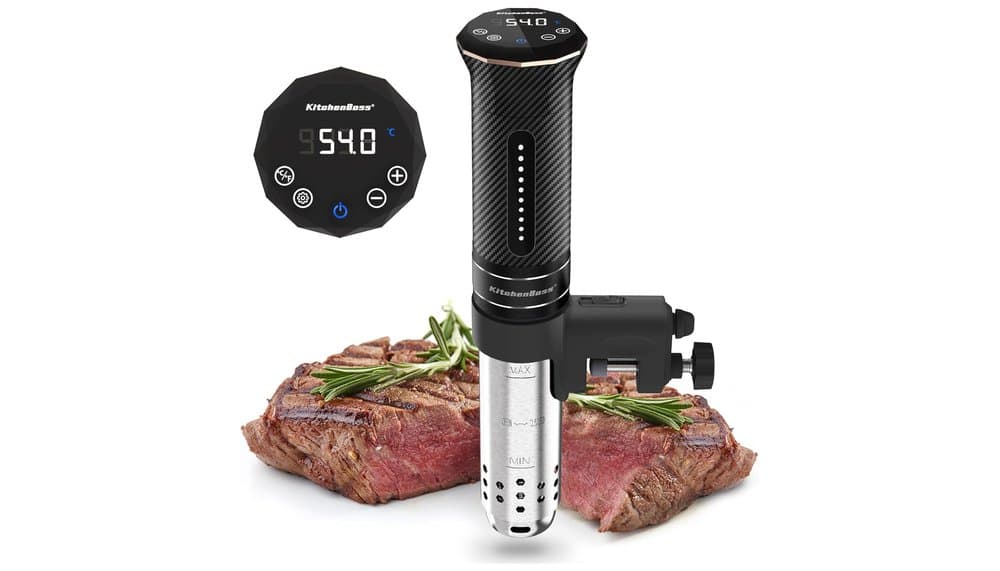
The KitchenBoss G300T takes a different approach, promoted by the brand as a "test winner" model on comparison sites. Its main selling point lies in its full SUS304 stainless steel construction, including the impeller and the entire immersed part. This finish aims to guarantee maximum durability and food safety, avoiding any prolonged contact of plastic with hot water.
On paper, its specs are robust: brushless motor (like in high-end drones) for extended lifespan, ultra-quiet design thanks to a helical stainless steel impeller, and an advertised water circulation of 16L/min. But its most distinctive feature is its built-in recipe menu directly on the device, a practical innovation to guide beginners without having to check a smartphone.
The community, which gives it an excellent rating of 4.7/5, unanimously praises its perceived high-end build quality and its very quiet operation. Temperature accuracy is described as extremely reliable. The reported limitations are more related to user experience: some find the interface with the built-in menu slightly more complex to master than a basic control screen. Furthermore, its all-stainless design and advanced features generally make it a bit bulkier and heavier than the Wancle, which is the flip side of its claimed robustness.
KitchenBoss G310 (Silver)
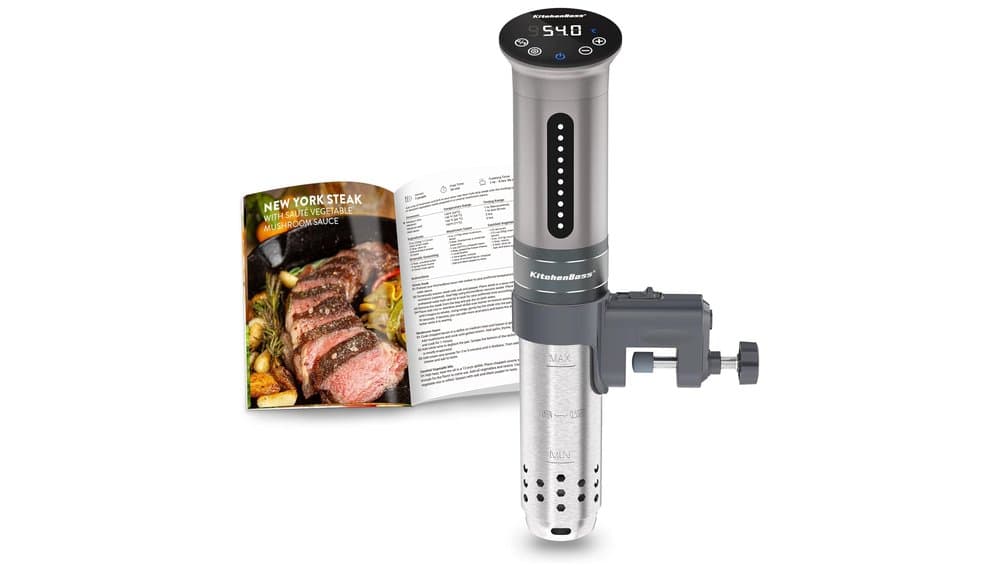
The KitchenBoss G310 (Silver) is, in a way, the brother of the G300T, sharing most of its technical DNA but with a few notable differences in presentation. It benefits from the same premium SUS304 stainless steel construction for the immersed part, the same powerful and quiet brushless motor (2900 RPM), and the same 16L/min water flow rate. It also displays an exceptional average rating of 4.7/5 based on a very large number of reviews (over 1800), a sign of lasting satisfaction over time.
What sets it apart, according to the brand's information, is its positioning. While the G300T focuses on the built-in menu, the G310 is often presented with an electronic recipe booklet (sent by email) developed by chefs. Its silver finish and its clean touch control screen give it a more minimalist and modern appearance. The temperature precision is advertised as ±0.3°C, which remains excellent for home use.
User feedback converges to make it a favorite due to its perceived excellent value for money. The highlighted strengths are its reliability, its ease of cleaning thanks to the IPX7 waterproof rating, and its formidable efficiency for consistent cooking results. The rare criticisms, as with the G300T, can be about an instruction manual sometimes considered too brief or the fact that, for very occasional use, it might seem oversized. It is clearly the option for those seeking the robustness and performance of professional models, without superfluous gadget functions.
Connectivity and Programs: From Simple Control to Guided Experience
Here, we leave the world of the simple machine to enter that of the personal cooking assistant. Connectivity is not just a gimmick to show off. It's the possibility to start a 36-hour cook from your office, to receive an alert on your phone when the core of your roast has reached the perfect temperature, or to follow a recipe step-by-step without having to think. But it all depends on what you really expect from it.
Remote Control: The True Comfort (When It Works)
Imagine this. You put your beef bourguignon in the bag in the morning, place the immersion circulator in the tub, and you leave for work. At 4 PM, from your sofa or your car, you start the cook via an app for a dinner ready at 8 PM. It's magic. But for it to be so, you need a reliable application and a stable connection.
The difference between Bluetooth and Wi-Fi is crucial.
- Bluetooth: Its range is limited (generally 10 meters without obstacles). Perfect if your kitchen is next to the living room, useless if you are at the office. It's often a basic start/stop function.
- Wi-Fi: This is true remote control. You can be on the other side of town. But this requires the device to connect flawlessly to your home network. Read reviews about the app's stability; it's often the weak point of connected models. A buggy app can turn your assistant into a source of anxiety.
Recipe Libraries: To Learn or To Save Time
Some applications come with hundreds of guided recipes. You select "Pork tenderloin, medium-rare," and the app automatically sets the temperature (say, 57°C) and the time (4 hours). It's a valuable aid for beginners or for exploring unusual cooks (like yogurt or perfect eggs). It removes all uncertainty.
But be careful, don't let an app dictate your judgment. A true enthusiast will always end up consulting detailed cooking tables (like those from Douglas Baldwin) and adjusting to their taste. The value here is in the ease of reproducibility. Once you've found your ideal time/temperature for chicken breasts, you can save it as a custom program and restart it with two clicks.
Alarms and Monitoring: Peace of Mind
This is, in my opinion, the most underrated feature. Being able to set an alert when the water temperature is reached (handy to avoid having to monitor the preheat), or, better yet, when the integrated probe (in high-end models) detects that the core of your roast has reached the target temperature, changes everything. You can go about your business without that little anxiety of "Is it cooking properly?"
To choose the best sous vide immersion circulator for you, ask yourself: am I an organized person who plans ahead and wants comfort (then Wi-Fi is king), or am I an instinctive cook who adjusts on the spot and prefers physical controls (a good touchscreen on the device will suffice)? Don't invest in a connected overcomplicated machine if you hate using your phone in the kitchen. Conversely, if you love tech and precision, these functions can be worth every extra euro.
The Sous Vide Ecosystem: Sealers, Accessories, and Finishing
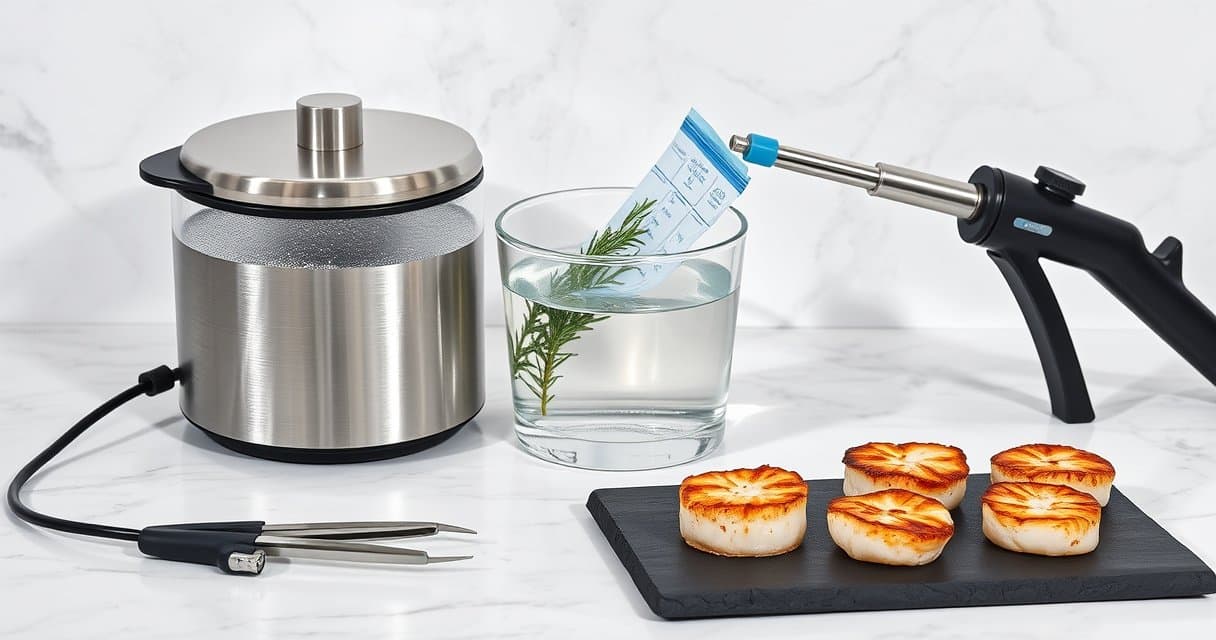
Having an immersion circulator is like having a sports car. To fully enjoy its performance, you need the right fuel and the right tires. Your machine doesn't exist in isolation. The complete experience involves what happens before cooking (vacuum sealing) and after (finishing), and these choices directly impact your results, your budget, and your enjoyment in the kitchen.
Vacuum Sealing: The Strategic (and Budgetary) Choice
This is the first crucial question. Without a proper vacuum, your bag risks floating, water can enter, and the cook will be compromised. Two philosophies compete here, with a significant price gap.
The External Vacuum Sealer (or Strip Sealer): This is the most common and least expensive model to purchase. It sucks the air from outside the bag, then seals. Simple. But here's the catch: it requires textured bags (with small grooves) so the air can escape. These bags are more expensive to use. And most importantly, it is not very effective with liquids or very moist foods (a marinade, a fish). You will often need to use the "pulse" function and pre-freeze the liquid, a real constraint.
The Chamber Sealer (or Vacuum Chamber): This is the serious investment. The food and bag are placed in a small chamber, the air is sucked out from all around, then the bag is sealed. The result? A perfect vacuum, even with soups, sauces, or very juicy fruits. The bags used are smooth, much cheaper per meter. For regular and ambitious use (preparing individual portions of stews, preserving herbs in oil), it's a total game changer. The appliance is bulkier and much more expensive, but the cost per portion balances out quickly.
Finishing: The Magic of "Crispness"
This is where the difference between technically perfect food and a truly exciting dish is made. Sous vide cooking makes meat uniformly tender and juicy, but it doesn't create a crust. You have to create it afterward.
The Kitchen Blowtorch (or Searzall): This is the fast, fun, and precise tool. Perfect for a steak or a fish fillet. You control every millimeter of browning. The downside? It can leave a slight gas taste if you're not gentle, and it's not ideal for large cuts.
The Cast Iron Skillet, with a Thick Bottom and Very, Very Hot: The essential. Dry your steak impeccably with paper towels. Heat your skillet until it's white-hot. Add a high-smoke-point oil (like grape seed oil). 30 to 60 seconds per side are enough for a magnificent crust. For a thick ribeye steak, press down on it with a spatula to maximize contact. It's noisy, it smokes up the kitchen, but it's divine.
The Oven on the "Broil" Setting: The solution for large cuts or large quantities. After the bath, place your roast on a rack with a tray underneath and put it under the oven broiler for a few minutes. This allows for uniform searing over the entire surface, without effort.
Practical Accessories (and Those to Avoid)
A sous vide cooking rack made of steel mesh is a purchase you won't regret. It prevents bags from sticking to the heating element and allows you to take out several portions at once. Clips for securing bags to the edge of the container are also very useful for long cooks.
Be wary, however, of "sous vide stones" or other gadgets supposedly meant to improve circulation. A well-designed machine doesn't need them. Instead, invest in a lid adapted to your container (extruded polystyrene works very well) to limit evaporation during 24h+ cooks and save energy.
Conclusion
Your low-temperature cooking adventure begins with the sous vide immersion circulator, but it does not end there.
Choose the machine that fits your pace and ambitions. Master its ecosystem. That is the guarantee of perfect repeatability, meal after meal.
Precision then becomes routine. And the results, a simple gourmet habit. Happy cooking!
Frequently Asked Questions
How to choose a powerful sous vide immersion circulator?
For serious use, aim for a minimum of 1100W, and prefer 1200W to 1500W for quickly heating and maintaining a stable temperature in a 20 to 30 liter container.
What is the ideal precision for an immersion circulator?
A precision of ±0.1°C is essential for perfect and reproducible results, especially for red meats and eggs, unlike entry-level models at ±1°C or more.
Is an immersion circulator waterproof?
A reliable model must imperatively have IPX7 certification, meaning it can be temporarily submerged in one meter of water and rinsed without damage.
Is a pump necessary in a sous vide immersion circulator?
Yes, a built-in circulation pump is indispensable for constantly circulating the water, eliminating cold spots, and ensuring perfectly even and safe cooking.
What container should be used with an immersion circulator?
For most uses, an 18 to 22 liter container is the most versatile; it is recommended to cover it with food-grade ping-pong balls to reduce evaporation during long cooks.
What is a good sealer for sous vide cooking?
For a perfect vacuum, especially with liquids, a chamber sealer is the serious investment, while an external suction sealer is more accessible but requires textured bags.
100% free and independent — All our articles are written independently, without any sponsorship. We may earn a commission on purchases made through our links, at no extra cost to you.
Guides you might like
Bell Jar Vacuum Sealer Buying Guide
Upgrade to a chamber vacuum sealer for professional sous-vide results at home. Perfect for liquids and flawless, long-lasting seals.
Best Beginner Sous Vide Kit
Find the perfect sous-vide starter kit on a budget. Learn the three essential features to look for to cook your first perfect steak without the headache.
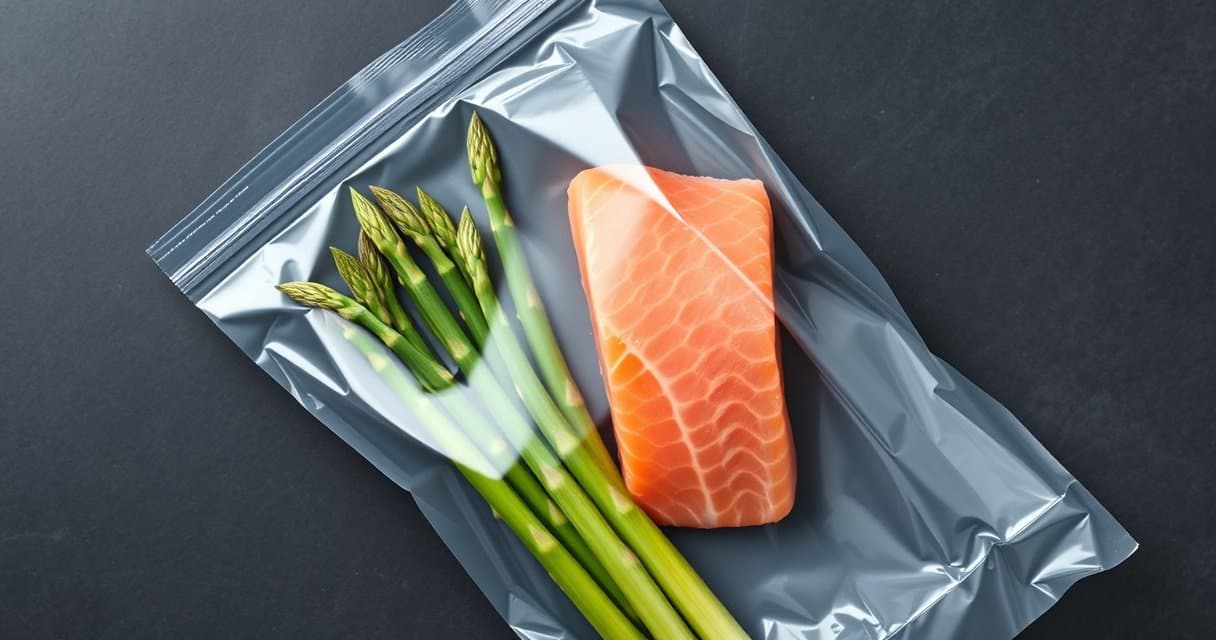
Best Vacuum Bags
Choose the right vacuum sealer bags for perfect results. Learn key specs like heat resistance, thickness, and barriers to avoid culinary disasters.
Articles you might like
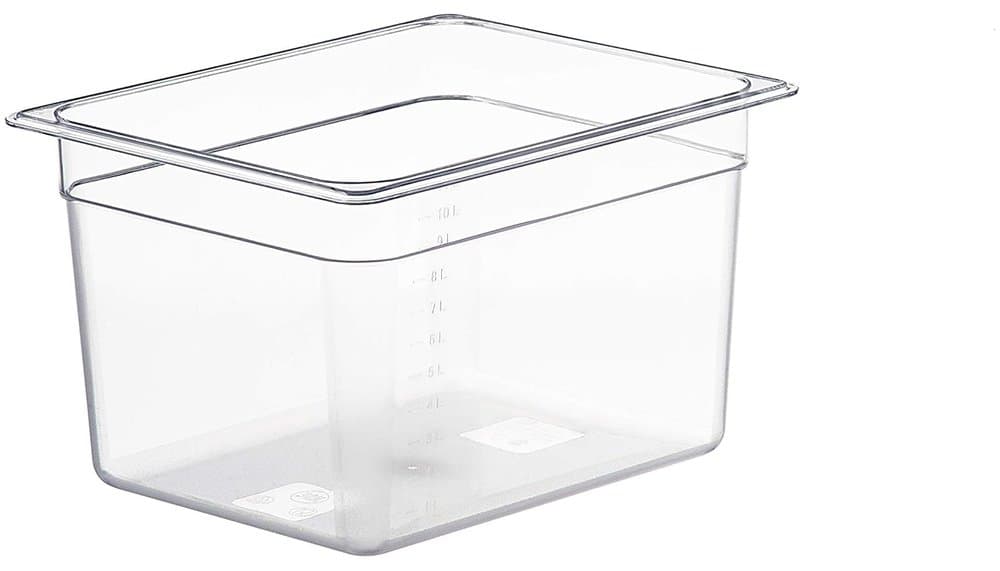
Lipavi C10 11.3 Liter Vacuum Container Review & Test
LIPAVI C10 sous-vide container review: analyzing its energy efficiency, thermal stability & ease of use for precision cooking.
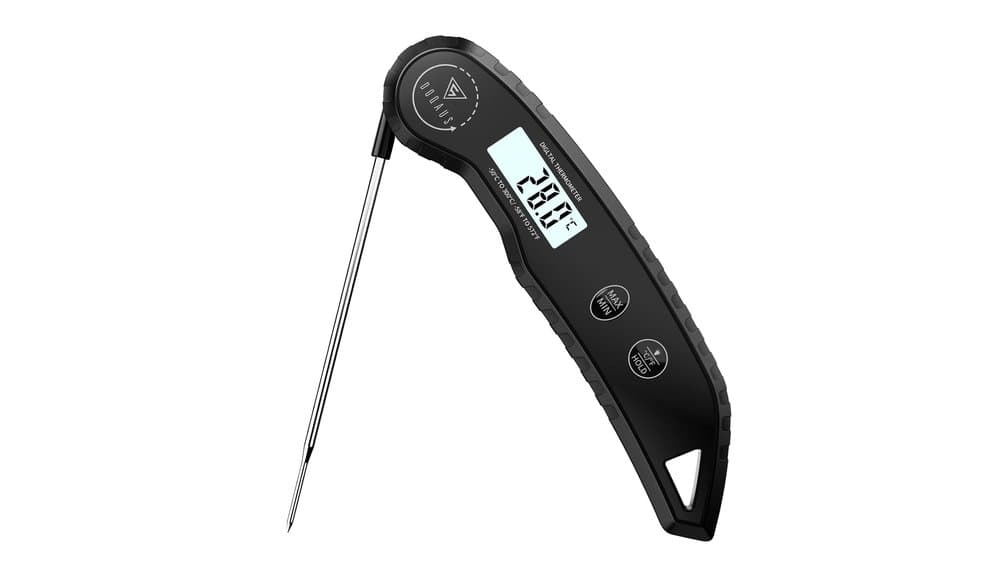
DOQAUS Instant Read Dial Thermometer Review
Master temperature for perfect cooking. Dial thermometer for instant, reliable readings on steak, syrup, ovens. Essential precision tool.
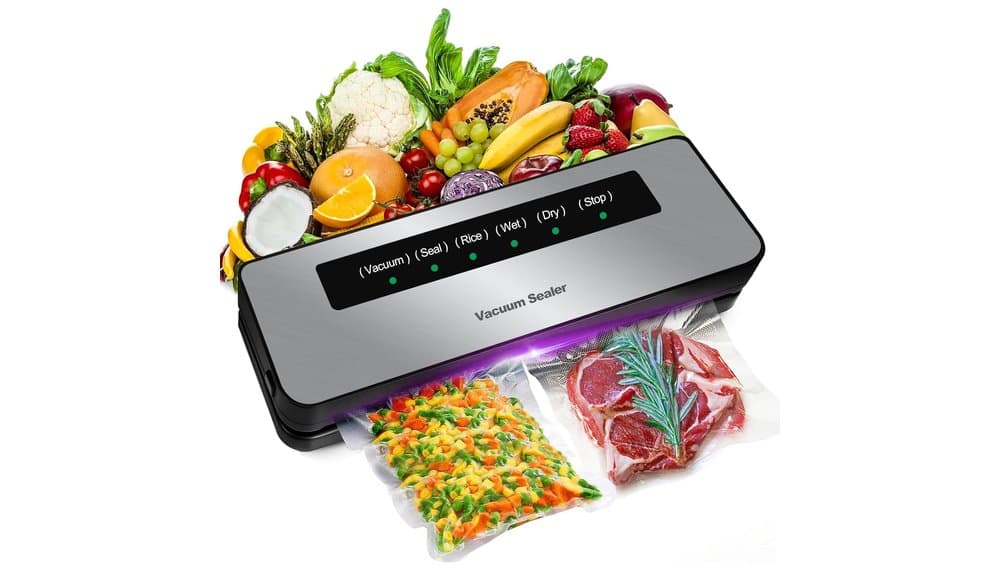
Dictien CF-001A 6-in-1 Sous Vide Machine Review
Ensure perfect sous-vide with the versatile Dictien CF-001A 6-in-1 vacuum sealer for both dry and moist foods. A comprehensive review.