Cast Iron Pan Buying Guide
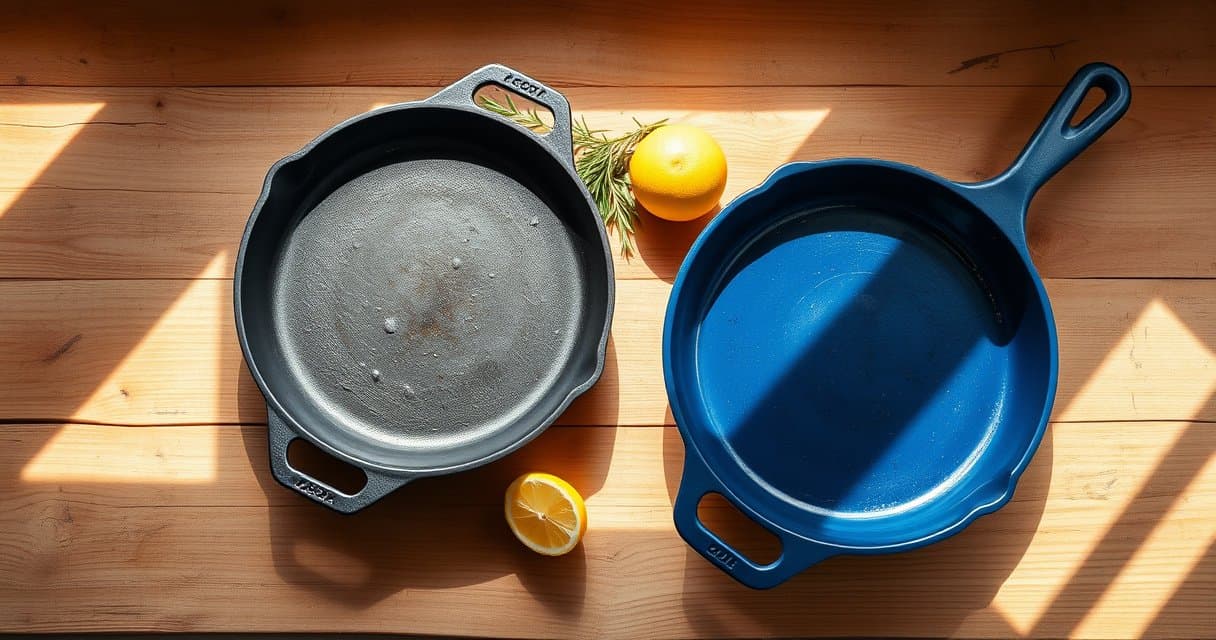
You know that frustration of seeing a disappointing steak, cooking unevenly and sticking to the bottom of the pan? It's often a matter of material. Choosing the right cast iron skillet is the key to radically transforming your sears and roasts at home. So, let me help you understand the different types and criteria so your next purchase is the right one.
Key Points to Remember
- Choose natural cast iron for perfect searing, and enameled cast iron for versatile, low-maintenance use.
- A 28 cm skillet is the most versatile size for cooking efficiently for a family.
- Check the handle's ergonomics and the weight for a comfortable and safe utensil to handle.
- Ensure the bottom is perfectly flat for optimal compatibility, especially on induction.
- It's a lifelong investment: well-maintained, a cast iron skillet lasts for decades.
Natural Cast Iron or Enameled: The Choice Based on Your Cooking Practice
This is THE number one dilemma. Frankly, many get it wrong by choosing by default without thinking about what they actually do in the kitchen. Your cooking style should decide for you.
**Natural cast iron is the champion of the best cast iron skillet for searing. It's a choice for the demanding. Its porous surface, once seasoned, develops a natural non-stick patina that becomes more and more effective over time. You get an incomparable Maillard reaction crust on a steak, without a trace of synthetic coating. However, it has its rules: no long cooking with acidic ingredients (a tomato or red wine sauce would attack it), and maintenance that requires a bit of attention after each use – perfect drying and light oiling. If your main goal is the perfection of quick grilling and high-heat searing, and you're willing to pamper your utensil, this is the one.
Conversely, enameled cast iron is the queen of quiet versatility. The vitrified enamel that coats it acts as a shield. No need for seasoning, it resists acids, and you can simmer a bourguignon in it for hours without worry. Cleaning is simple: a quick wipe with a sponge and it's done. On the other hand, for pure searing, it's a notch below its natural cousin. The enamel is a little less "grippy" for food, which can sometimes hinder the formation of a perfect crust. It is also often more expensive to purchase. It's the ideal option if you want a single skillet to do everything, from cooking morning eggs to the Sunday roast, without ever worrying about maintenance.
So, for you, which one?
- Are you a grilling and precision enthusiast? You love the maintenance ritual and seek the ultimate tool for a best cast iron skillet for searing? Natural cast iron is your ally.
- Do you cook a bit of everything, quickly and well, and hate constraints? You love tomato sauces and saucy dishes? You just want to take the skillet out of the cupboard and use it without a protocol? Enameled will simplify your life.
The Right Size for Your Needs: From Single Serving to Family Meal
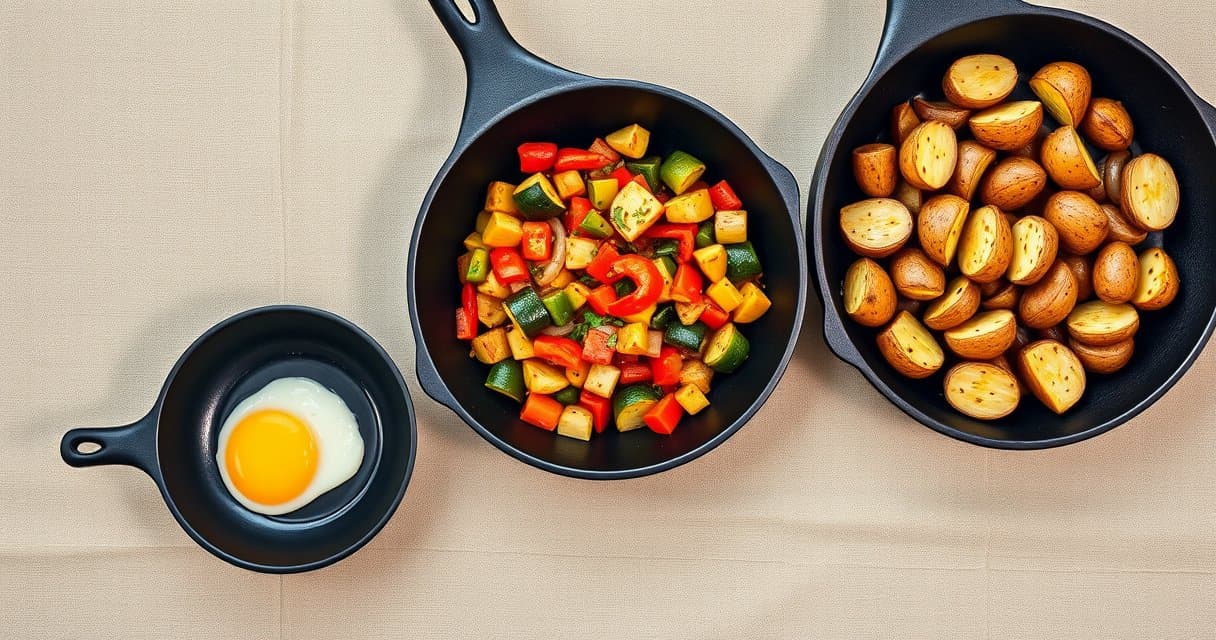
Choosing the size is often the classic mistake. We think "bigger is better" and end up with a 4-kilogram monster impossible to handle for a simple chicken breast. Conversely, a pan that's too small forces you to cook your steaks in batches, and you lose that beautiful uniform temperature so crucial for the best cast iron pan for searing.
Diameter and Daily Use
Let's talk numbers. A pan measuring 20 to 24 cm is perfect for one to two people. It excels at searing a boneless whole chicken, two fish fillets, or vegetables for a side dish. It heats up quickly, is lighter, and easier to store. But if you cook for a family or like large cuts, you'll quickly feel limited.
The 28 cm diameter is, in my opinion, the most versatile. It's the standard size for a reason: it allows you to sear two thick steaks or three lamb chops at once, without them touching. This is essential. If the pieces are too crowded, they will steam instead of sear. You maintain a hot enough surface to get a perfect crust on all the meat.
Beyond 30 cm, you enter the territory of festive meals and cooks very comfortable with weight. Ideal for roasting a whole chicken or a large roast, it quickly becomes cumbersome for daily use. Honestly, unless you regularly feed a crowd or cook in large quantities, the 28 cm is a better compromise.
Weight, The Overlooked Enemy
Diameter is one thing. But the real trap with cast iron is the associated weight. A natural cast iron pan of 28 cm easily weighs 3 to 4 kg empty. Add 1 kg of roast to that, and you have a serious load to handle with one hand. Always check the weight specified by the manufacturer. If you have fragile wrists or a small kitchen where everything has to be taken out of a high cabinet, a smaller pan (24 cm) or one with a second small handle on the opposite side will be a real relief. Ease of use is just as important as performance.
Our Selection
Whether you want to sear a steak perfectly, create beautiful grill marks on your vegetables, or simply prepare a healthy meal, the cast iron skillet remains a kitchen staple. We have scrutinized the specifications and community feedback to present you with three flagship models. No product is perfect, and our role is to shed light on their strengths and compromises so you can find the one that truly matches your cooking style.
To compare these three models at a glance, here are their main characteristics:
| Product | Material / Coating | Weight | Compatibility (stovetop/oven) | Key Strengths |
|---|---|---|---|---|
| YASHE Cast Iron Frying Pan | Bare cast iron | 2.88 kg | All stovetops, oven, fire | Extreme versatility, legendary durability |
| Chefarone Enameled Cast Iron Grill Pan | Enameled cast iron | 2.46 kg | All stovetops, oven | Simplified maintenance, practical serving design |
| Baumalu Square Grill Pan | Cast iron + non-stick coating | 1.76 kg | All stovetops (oven NOT) | Lightweight and compact, retractable handle |
YASHE Cast Iron Frying Pan
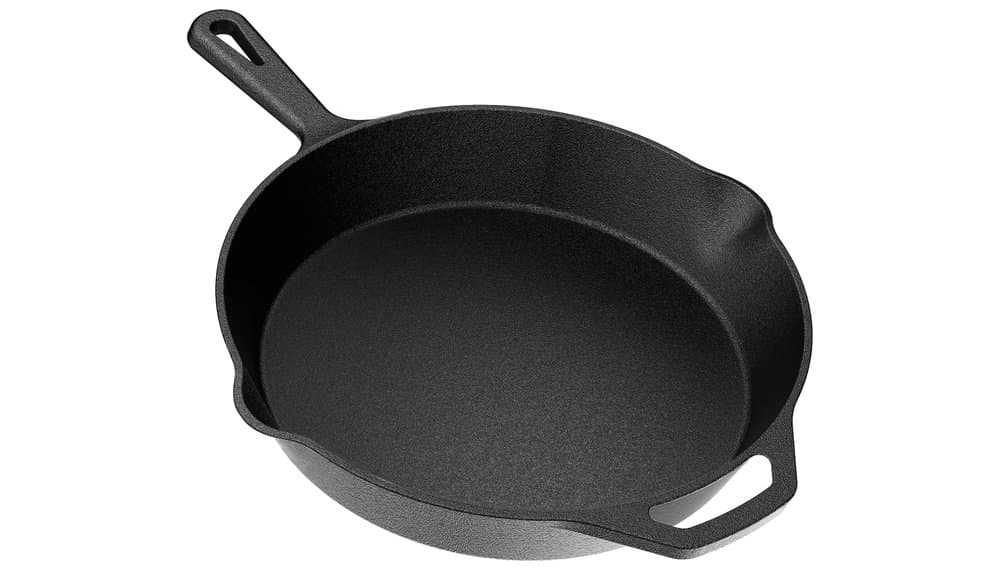
We start with a timeless classic: the bare cast iron skillet. On paper, the YASHE specifications promise near-absolute versatility. It claims to go seamlessly from a campfire to an induction hob, and even into the oven, making it a true Swiss Army knife for lovers of traditional cooking and barbecue enthusiasts. Its 3-liter capacity and flat surface make it a tool suited for large quantities and perfect sears, not forgetting the pouring spouts which, according to user feedback, make it easy to pour off sauces.
Where the community is unanimous is on the notion of durability. Reviews emphasize that, when well maintained (meaning properly seasoned), this skillet is built to last for decades. Its ability to reach very high temperatures and retain heat for a long time is also highly praised for achieving a perfect crust on a piece of meat. However, this is also where its limitations lie. According to feedback, its 2.88 kg weight makes it somewhat unwieldy, especially when full. Furthermore, bare cast iron requires specific maintenance: it is not dishwasher safe, fears prolonged acidity (like a long-cooked tomato sauce), and requires immediate drying to prevent rust. In summary, the YASHE is an investment for purists ready to maintain their tool in exchange for exceptional performance and longevity.
Chefarone Enameled Cast Iron Grill Pan
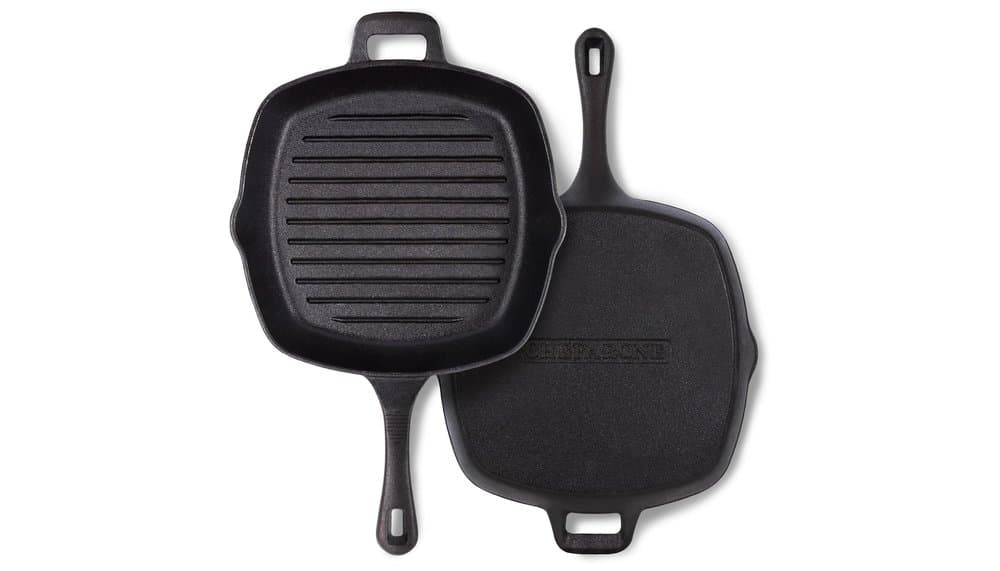
Chefarone's model takes the cast iron concept and adds a touch of modernity with an interior and exterior enamel coating. This is its main difference from the YASHE. According to user feedback, this enamel offers greatly simplified maintenance: no seasoning required, natural resistance to rust, and compatibility with gentle soap washing (although the brand still advises against dishwashers). Its ridged (grill) surface is designed to create beautiful marks on steaks and vegetables while allowing some fat to drain away, promising a somewhat healthier cook.
Community reviews highlight several concrete strengths. The heat distribution and retention are judged to be excellent, inherited from the cast iron core. The design with its raised edges and pouring spout is particularly appreciated for serving directly at the table, making the skillet an elegant serving dish. Its weight, although substantial (2.46 kg), is slightly less than that of bare cast iron. But this enamel also has its drawbacks. Users note that it can be sensitive to sudden thermal shocks (avoid going from a very hot oven to a cold surface) and to scratches from metal utensils. Additionally, the ridged surface is sometimes mentioned as less versatile than a smooth bottom for cooking delicate foods like scrambled eggs. It is therefore the ideal choice for those who want the benefits of cast iron without the seasoning constraint, prioritizing grilling and table service.
Baumalu Square Grill Pan
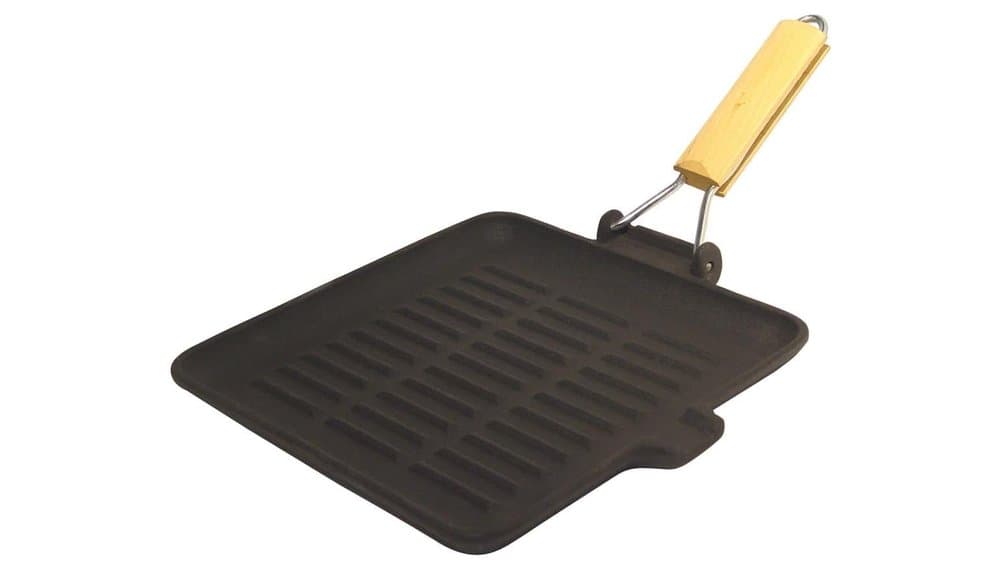
With the Baumalu, we enter a different category, focused on compactness and practicality. It's the lightest in our selection at 1.76 kg, a very noticeable difference in use according to testimonials. Its most distinctive feature is undoubtedly its retractable wooden handle. Customer reviews are clear: this function is a major asset for storage, allowing the pan to be slipped into a drawer or narrow cabinet, and for secure handling without the risk of burning oneself on a hot metal handle.
The specifications indicate compatibility with all hobs, including induction, making it very accessible. Its 24 cm square format is considered clever for optimizing space on a cooktop and fitting several foods well. However, the community notes several important compromises. First, the "non-stick" mention and the non-removable handle strictly forbid use in the oven, severely limiting its versatility compared to the other two models. Secondly, although lighter, some feedback questions the long-term robustness of the coating and the handle mechanism under intensive use. Finally, its ridged bottom shares the same versatility limitation as the Chefarone's for cooking that requires a completely smooth surface. The Baumalu is therefore the perfect candidate for cooks with limited space, singles, or small households, who are primarily looking for a practical, easy-to-store, and lightweight griddle for healthy daily grilling.
Ergonomics and Handling: Avoiding Surprises with Weight and Handles
You've chosen the type and size? Perfect. Now you need to test the handling. This is often where things go wrong. A better cast iron skillet for searing must be manageable, otherwise it will end up at the back of the cupboard. You don't cook well with a tool that scares you or tires you out.
The Crucial Importance of the Handle
This is your single point of contact with the hot skillet. Don't neglect it.
- Length: A handle that's too short exposes you to the heat from the flame and makes handling unsafe. It should be long enough to provide good leverage, allowing you to control the skillet with one hand.
- Material and Insulation: Bare metal conducts heat. After 10 minutes on the fire, it becomes impossible to touch without a folded towel. Look for a handle made of steel sheathed in a heat-resistant material, like silicone or thick, well-fixed wood. This is invaluable daily comfort, especially when you need to tilt the skillet to baste a roast with its juices.
- Shape and Safety: Ensure the junction between the handle and the skillet body is robust, without sharp angles that could hurt your palm. Some models even integrate a hole for hanging, a practical detail.
The Second Handle, an Asset for Large Sizes
For skillets 30 cm and larger, a small handle or steel knob opposite the main handle is not a gimmick. It's a necessity. It allows you to lift and handle the skillet safely with two hands, especially when taking it out of the oven where heat radiates from everywhere. Without it, pouring a preparation into a dish becomes a perilous exercise. Frankly, for any skillet meant to go in the oven, this is a deal-breaker.
The Decisive Test: Imagine the Movement
Before buying, even online, do this mental exercise. Imagine the skillet filled with a 2 kg roast. Can you lift it one-handed from the stove to the sink to deglaze? Can you gently tilt it to flip potatoes? If the answer is no, the tool is not suited to your strength and your cooking style. Ergonomics is what turns a utensil from an object of torture into a natural extension of your hand.
The Role of Your Cooktop in Choosing Your Pan
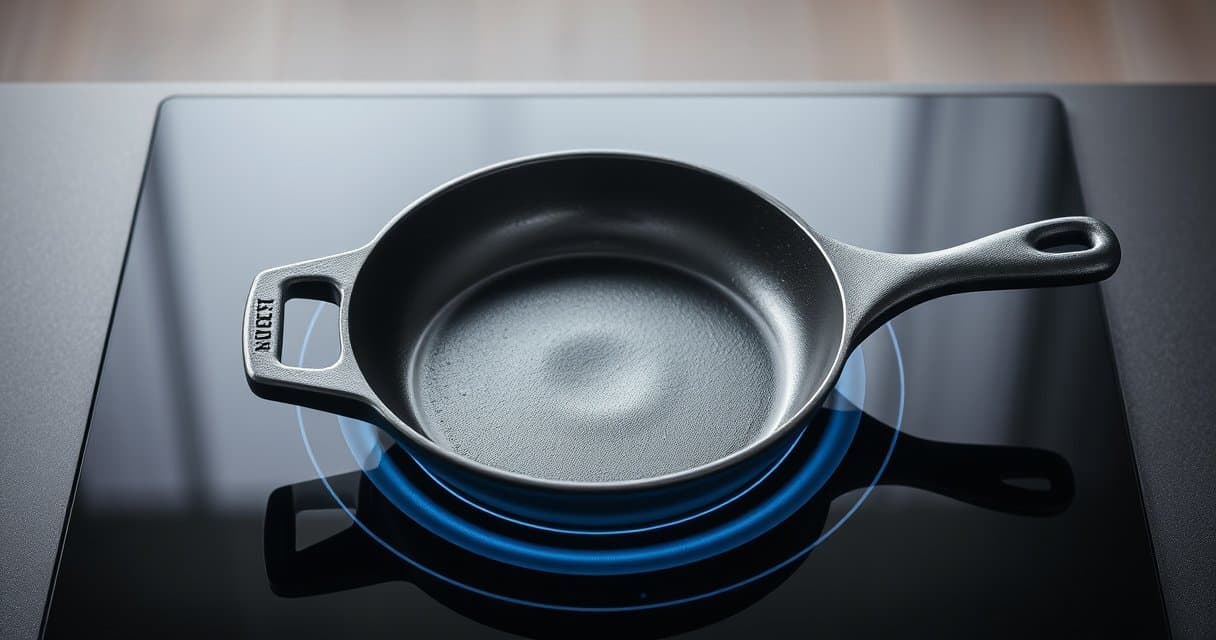
We often think about it after the fact, and that's a mistake. Compatibility with your heat source is crucial. Cast iron that doesn't heat evenly or that slides on your cooktop will never be the best cast iron pan for searing. Here's what to check, depending on your equipment.
Induction, the champion... if the base is perfectly flat
If you have an induction cooktop, you have an advantage for searing: ultra-fast heat-up and precise temperature control. But cast iron, due to its casting process, can have a slightly convex or irregular base.
- The ruler test: Ideally, before buying, place a metal ruler on the bottom of the pan. You should not see any light passing underneath. Even a slight deformation, on the order of a millimeter, can create a reduced contact point and cause uneven heat, making your steak "spin" instead of searing evenly.
- The symbol and the magnet: Check for the induction pictogram (a spiral). Even without it, if a magnet sticks firmly to the bottom, it will work. But only a guaranteed flatness will ensure optimal performance.
Ceramic glass and gas: pay attention to stability
On a ceramic glass or electric cooktop, a heavy cast iron pan is an advantage... as long as it doesn't scratch your surface. Ensure the bottom is absolutely smooth, without any roughness or foundry sand grain that could damage the cooktop. For gas, it's much simpler: you have universal compatibility. However, the flame may not envelop a very wide base as well. Choose a burner size suited to the diameter of your pan to avoid cold spots on the edges.
The oven, your ally for finishing touches
Don't forget this aspect! One of the strengths of cast iron is being an all-rounder: from direct stovetop heat to the oven to finish cooking. Check that the handles are entirely metal or designed to withstand high temperatures (often up to 200°C or more). If you have plastic or wood handles with exposed screws, they probably won't go in the oven, which greatly limits the usefulness of the utensil for dishes like a whole roast chicken.
Mastering Seasoning: Methods for Natural Cast Iron and Simplified Maintenance
This is the most intimidating topic: seasoning. But frankly, we make too big a deal of it. To get your best cast iron pan for searing, you just need to understand it's a process, not a test. The idea is simple: create a protective, non-stick, rust-preventing layer by polymerizing oil on the porous surface of the cast iron.
Initial Seasoning: The Solid Foundation
If your new pan looks dull and grey, it needs a first seasoning. Forget overly complex methods with six different layers of oils.
- Clean it with hot soapy water, rinse, and dry it completely on the stovetop over low heat.
- Apply a thin film of high-smoke-point oil (duck fat, grapeseed oil) over the entire surface, inside and out. The secret? Wipe it with a paper towel as if you made a mistake. Only an imperceptible veil should remain.
- Place it upside down in a cold oven. Put it in, heat to 200°C, and let it bake for one hour. Turn off the oven and let it cool completely inside.
Repeat this operation once or twice. You'll see a golden to brown patina appear. You're good to go.
Daily Maintenance: Simple but Non-Negotiable
Here is your winning routine after each use of a natural cast iron pan:
- Never dishwasher. Aggressive detergents would dissolve the seasoning.
- Clean with hot water using a soft brush or abrasive coarse salt. For stubborn residue, heat a little water in it, scrape gently with a wooden spatula, and rinse.
- The crucial step: dry it immediately and completely on the stove. Bring it to a simmer to chase away any trace of moisture.
- Once dry and still warm, rub a very small oiled cloth on the inside. It's a 30-second gesture that nourishes the seasoning and prevents rust.
And Enameled Cast Iron? The Mistake Not to Make
Here, it's different. The enamel is not seasoned and is not porous. Its maintenance is much simpler: hot water, mild dish soap, non-abrasive sponge. The trap is believing it is as non-stick as a synthetic coating. It is not. For a good sear, you need to preheat the enameled pan gradually (5 minutes over medium heat) and use fat. Frankly, skipping this step is a guarantee that everything will stick.
The key, with natural cast iron, is to consider it as a partner that improves over time. Each cooking session, each small oiling enriches it. Don't panic if some food sticks a little or if the patina seems uneven at first. Keep cooking and maintaining it, and it will eventually become your most reliable utensil.
Understanding the Price of a Cast Iron Pan and Its Long-Term Investment
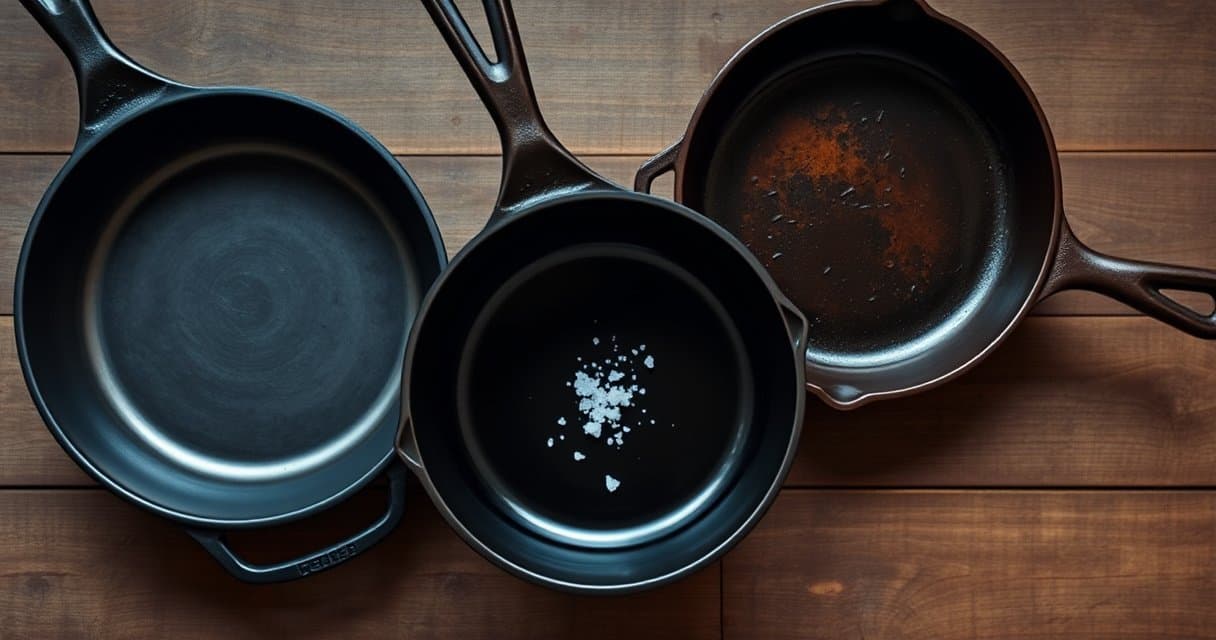
The price of a cast iron pan can be surprising, with a range from 40 to over 300 euros. This isn't just about brand or marketing. It's a real investment, and to justify it, you need to look at what you're actually buying over the long term.
Where Does the Price Difference Come From?
The gap is explained by several concrete factors, well beyond just looks.
- Manufacturing and Finish: A low-end cast iron piece is often rougher, with less refined edges, a more pronounced surface grain, and sometimes even micro-imperfections. A mid-range or high-end piece is carefully machined, smoothed, and inspected. For enameled pans, the quality and thickness of the enamel, as well as the complexity of firing the colors, significantly increase the cost.
- The Small Details That Cost More: An ergonomic handle, securely riveted and heat-resistant (sheathed in stainless steel or composite material) adds to the price, but also to comfort and safety. Similarly, a tempered glass lid with a steam vent, or a perfectly flat bottom for induction, are features you pay for.
- The Warranty: A brand that offers a lifetime warranty or a warranty spanning several decades isn't just being generous. It's a sign they have confidence in the intrinsic durability of their products. It's not an accessory; it's part of the value.
Should You Always Aim for High-End?
Frankly, no. The best cast iron pan for searing isn't always the most expensive. Here's how to think about it:
- For occasional use, to try cast iron without breaking the bank, or for a secondary size (a small egg pan), an entry-level model in bare cast iron (between 40 and 70€) will do the job very well. It will sear just as well as another. Its maintenance will simply be more demanding to maintain the seasoning.
- Invest in mid/high-end (starting around 100-150€ for bare cast iron, much more for enameled) if it's your main piece of cookware, used several times a week. You'll be paying for longevity, the finish that makes maintenance easier, and the peace of mind from the warranty. It's the purchase for 20 years or more.
The 10-Year Cost Analysis: The Decisive Argument
This is where everything becomes clear. Compare it with a "standard" non-stick pan at 30€, which needs replacing every 18 to 24 months when the coating degrades. Over 10 years, you'll buy 5 or 6 of them, for a cost of 150 to 180€ minimum, not to mention the waste. A good cast iron pan at 120€, well-maintained, will still be there in 10 years, probably in better condition than on day one. The cost per use is minimal. It becomes an heirloom, not a disposable item. You are paying for permanence and consistent performance. It's not an expense; it's a saving.
Conclusion
Choosing your cast iron skillet isn't just a matter of budget or aesthetics. It's a choice for the quality of your cooking, for temperature control, and for decades of successful meals.
Take the time to ask yourself the right questions about your practice. Natural cast iron for the purist, enameled for the pragmatist. The right size, the right weight, for your comfort.
Frankly, it's one of the best investments you can make in the kitchen. Once you've tasted a perfectly seared piece of meat, you won't go back. So, the ball is in your court.
Frequently Asked Questions
What is the best cast iron skillet for searing meat?
Unglazed, seasoned cast iron is the best for searing, as its porous surface develops a natural non-stick patina that allows for an unmatched Maillard reaction crust.
Natural cast iron or enameled cast iron, which one to choose?
Choose natural cast iron if you prioritize perfect quick searing and accept its maintenance, and opt for enameled cast iron if you are looking for versatility and simple cleaning, especially for saucy dishes.
What size cast iron skillet to choose for 4 people?
A diameter of 28 cm is the most versatile for 4 people, allowing you to sear two thick steaks or three chops without them touching and steaming each other.
How to maintain and season a natural cast iron skillet?
Clean it with hot water without a dishwasher, dry it perfectly over heat, and apply a thin veil of oil after each use; for the initial seasoning, coat it with a thin layer of oil and heat it in the oven at 200°C for one hour.
Does a cast iron skillet work on an induction cooktop?
Yes, provided its base is perfectly flat; check for the induction symbol or test with a magnet, and ensure there is no warping for even heat distribution.
Why is a cast iron skillet a good investment?
It is a long-term investment because, unlike a non-stick skillet that needs replacing every 2 years, a well-maintained cast iron skillet lasts for decades, which reduces its cost per use and waste.
100% free and independent — All our articles are written independently, without any sponsorship. We may earn a commission on purchases made through our links, at no extra cost to you.
Guides you might like
Bell Jar Vacuum Sealer Buying Guide
Upgrade to a chamber vacuum sealer for professional sous-vide results at home. Perfect for liquids and flawless, long-lasting seals.
Best Beginner Sous Vide Kit
Find the perfect sous-vide starter kit on a budget. Learn the three essential features to look for to cook your first perfect steak without the headache.
Best Vacuum Bags
Choose the right vacuum sealer bags for perfect results. Learn key specs like heat resistance, thickness, and barriers to avoid culinary disasters.
Articles you might like
PHOVOLT WiFi Thermometer with Probe Test
For precise sous-vide & charcuterie, a calibrated core temperature probe is essential to ensure perfect results where it matters most.
KitchenBoss Food Vacuum Bag Roll Review & Test
KitchenBoss vacuum sealing bags for sous-vide: analyze specs, compare performance, and determine value for precision cooking storage and preparation.
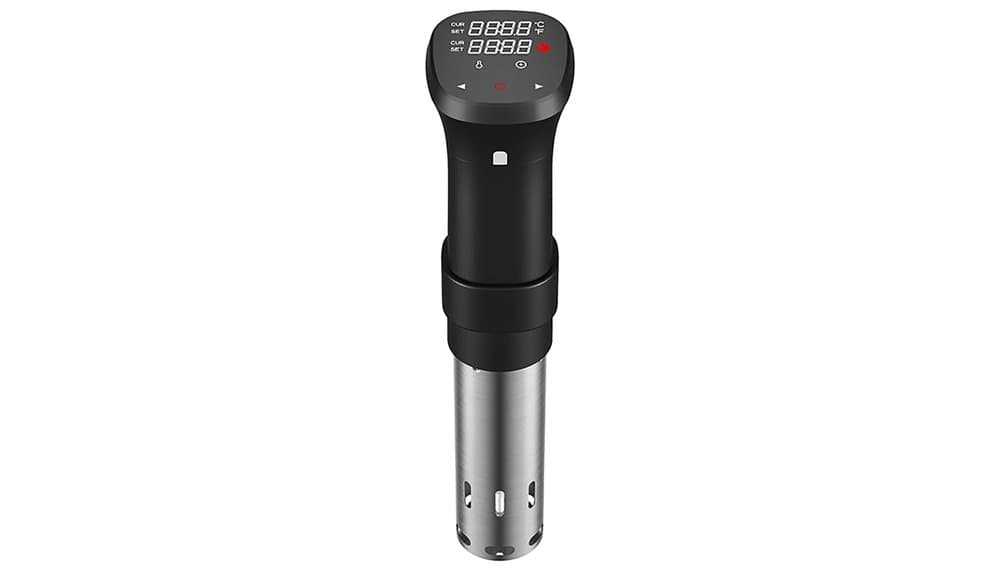
Fityou HU-XI-53 Immersion Circulator Sous Vide Cooker Review
Fityou HU-XI-53 Immersion Circulator review: A high-performing, accessible sous vide cooker with 1100W power, precise 0.1°C accuracy, and a 25-95°C range.